

When Occultists Go Back to Church
As contemporary occultists increasingly turn to traditional Christianity for ritual and community, Marco Visconti warns against letting aesthetic appeal blind us to the political dangers of religious restriction.
The audio edition is a member perk.
Become a member to listen to this piece, narrated by a real human voice.
Across contemporary occulture, particularly within the grimoire revival, traditional witchcraft, and those online spaces increasingly fascinated by Catholic and Orthodox ritual, there is a noticeable movement towards Christianity as a source of aesthetic seriousness, historical continuity, and organised community. For me, one of the ground zeros of this tendency was the late Jake Stratton-Kent insisting, already in the early 2010s, that we had collectively to “grow up and get over” our resistance to Christianity because it is the culture that suffuses our entire understanding of Western esotericism. That is undeniable. Even Crowley admitted as much. Yet recognising the depth of an inheritance is very different from surrendering our critical judgement to it, especially when that inheritance is once again being weaponised in public life.
My strong suggestion to anyone disgusted by the present state of occulture is to resist the urge to seek refuge in Christianity’s mystical and magical dimensions, since this may simply replace one set of unresolved problems with another without confronting the underlying issues that produce dissatisfaction within occulture.
From a specifically Thelemic perspective, this conversation must begin with Chapter 3 of Liber AL vel Legis, whose savage iconoclasm cannot honestly be brushed aside in the name of ecumenical politeness. Ra-Hoor-Khuit turns against the inherited gods and creeds with deliberate violence, attacking the authority claimed by Christianity alongside Islam, Hinduism, Buddhism, and every religious system that would place itself between the individual and the discovery of Will. Such language is often appalling to modern sensibilities, and it would be grotesque to interpret it as permission to persecute believers. Its purpose is symbolic, initiatory, and aeonic. It desecrates the old images precisely because those images had been presented as sacred beyond question.
Chapter 3 exists, among other reasons, to prevent Thelema from being quietly absorbed back into the religions it was written to overthrow. Its target is not every private experience of Christ, Mary, prayer, or mystical union. It is the power of inherited religion to define the limits of human possibility, to sanctify submission and to present its historically contingent morality as the eternal decree of heaven. Ra-Hoor-Khuit does not ask politely for a little room beside the old gods. He breaks their claim to sovereignty.
The Longing for the Old Sanctuary
The recent trend of occultists gravitating towards Christianity, particularly its more ritualistic expressions such as Catholicism and Eastern Orthodoxy, warrants critical attention because it reflects deeper needs for stability, meaning, and communal belonging within contemporary occulture. This can be seen in the popularity of online communities such as the “TradCath” subculture on Twitter (now X), the emergence of YouTube channels dedicated to Catholic aesthetics and ritual, and podcasts like “The Liturgy Guys” and “Catholic Stuff You Should Know” that attract listeners from alternative spiritual backgrounds. The attraction is easy to understand, and dismissing these people as merely foolish or reactionary would miss the mark. Contemporary occulture is fragmented, unstable and overwhelmingly mediated via screens. For instance, participants may move from following a TikTok occult influencer to joining Discord servers like “WitchTok,” or subscribing to online tarot workshops, accumulating techniques and terminology without ever entering a community capable of remembering one’s name, marking the stages of one’s life or remaining physically present when circumstances become difficult.
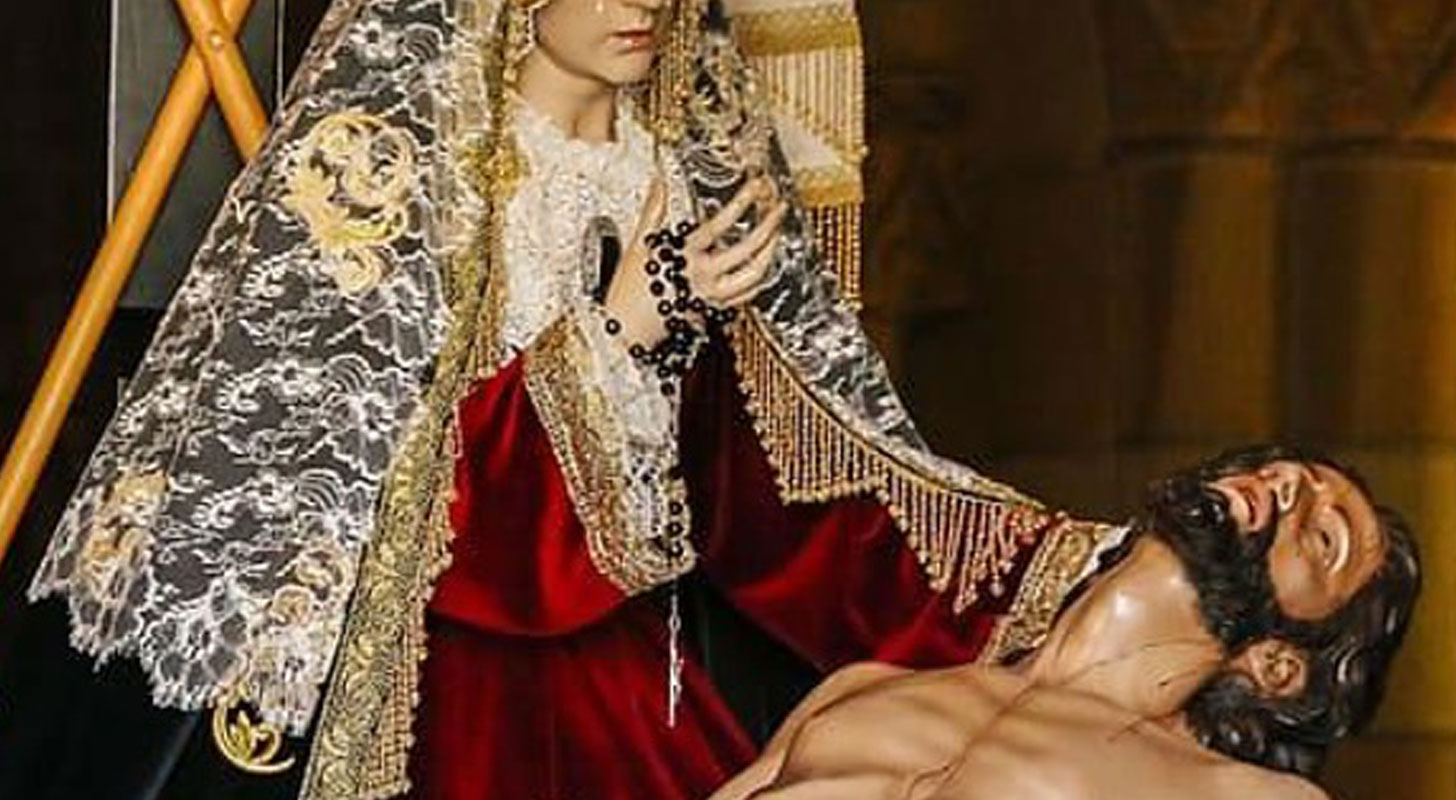
Catholicism offers something materially different. It has buildings. It has regular services, ritual calendars, established congregations, and ceremonies that have accumulated meaning throughout centuries. It provides places where one may simply arrive, sit down and participate without first having to invent a personal cosmology or deal with the vanity of another self-appointed occult teacher. There are candles, incense, vestments, sacred music, and gestures repeated until they enter the body. The ritual does not occur in a rented room above a pub, decorated half an hour before everyone arrives and cleared immediately afterwards. It takes place in a space deliberately set apart, sometimes within architecture that has survived generations of worshippers.
There is also the promise of organised community. A parish may contain families who have known one another for decades. It can provide pastoral care, practical assistance, and ceremonies for birth, marriage, illness, and death. Even when the reality falls far short of the promise, the institutional form exists. Occulture, by comparison, is often very good at selling initiation and remarkably poor at accompanying anyone through an ordinary human crisis. It can teach a person how to invoke archangels while leaving them entirely alone when they are bereaved, unemployed, or seriously ill.
Thelemic organisations have largely failed to answer this need. For all our talk of fraternity, initiation, and the establishment of the Law, we have built few enduring temples and even fewer healthy communities. Much of institutional Thelema consists of small groups meeting in borrowed spaces, sustained by exhausted volunteers and repeatedly destabilised by personality conflicts, financial precarity, sexual misconduct, or arguments over who possesses the most authentic transmission. The online world has expanded access to Thelemic material beyond anything Crowley could have imagined, which is valuable, but access to information cannot substitute indefinitely for embodied culture. A livestream does not become a temple simply because a ritual is being transmitted through it.
We should therefore understand why someone entering a Catholic church after years of algorithmic occultism might experience an enormous sense of relief. Here, at last, appears to be weight, continuity, and seriousness. Nobody is trying to explain the entire tradition in a fifteen-second video. The priest is not advertising a new personal system every month. The building itself seems to say that spiritual life can endure beyond the lifespan of the latest occult personality.
The aesthetic attraction is equally powerful. Traditional Catholicism understands that human beings respond to sound, scent, colour, posture, and atmosphere before they formulate intellectual propositions. A sung Mass in a darkened church can convey an experience of order and transcendence that a pile of books cannot reproduce. After years spent among badly designed occult paraphernalia, improvised rituals, and the unremitting commercial language of personal empowerment, Catholic ceremonial can feel like the recovery of an entire sacred world.
Yet ritual is never merely decoration. It teaches through the body, shaping what seems natural long before the intellect has consciously assented to doctrine. The beauty of the Mass carries a theology of authority, sacrifice, and salvation. The architecture places some people at the altar and others in the congregation. The institution determines who may administer the sacraments, whose relationships it recognises, which bodies may exercise authority, and what forms of life it considers disordered. One cannot indefinitely extract the incense, Latin, and Gregorian chant while pretending that the structure producing them is irrelevant.
This does not mean that everyone drawn to Christian mysticism will become a reactionary, nor that every Catholic or Orthodox community is politically authoritarian. Many Christians actively resist the capture of their religion by the far right, often at considerable personal cost. Christian mystical literature contains remarkable works of psychological subtlety, devotional intensity, and spiritual beauty. Western occultism is itself saturated with Christian material, from the grimoires, Rosicrucianism, and the Golden Dawn to the Abramelin operation and the Christian Qabalah. Thelema did not emerge from a historical vacuum. Crowley’s violent rejection of his Plymouth Brethren childhood never prevented him from working with inherited Christian forms, symbols, and theological problems. The Gnostic Mass itself transforms the Christian sacramental imagination rather than simply discarding it.
When Beauty Becomes an Alibi
The danger begins when aesthetic admiration becomes political innocence. The existence of Meister Eckhart, Marguerite Porete, Teresa of Ávila, or a secret Gnostic reading of the Eucharist does not neutralise the public power exercised by churches and Christian political movements. Part of the psychological appeal for occultists lies in the belief that by uncovering a supposed hidden or authentic form of Christianity, they participate in a privileged spiritual discovery distinct from mainstream religious institutions. This sense of uniqueness can offer personal validation and a feeling of intellectual or spiritual superiority, particularly when contrasted with the perceived banality of established religious authority. Yet, even if they have accessed one of Christianity’s many genuine possibilities, that private discovery still does nothing to restrain the people currently using Christian language to control schools, medical care, reproductive rights, gender expression, and the legal recognition of relationships.
We are living through a period in which reactionary Christians are manufacturing excuses to reclaim their former monopoly over our collective culture. Christianity is again being presented as the natural foundation of morality, family, nationhood, and citizenship, as though everyone else were merely a tolerated visitor in a civilisation that properly belongs to the faithful. Comparable authoritarian tendencies exist within the other religions of the Book wherever doctrine is converted into state power, but in Britain, Europe, and the United States the immediate political threat is plainly Christian reaction, frequently disguised as concern for tradition, children, or social cohesion. For example, recent legislative efforts in several U.S. states to restrict the rights of LGBTQ+ individuals have been explicitly justified through Christian rhetoric about the protection of family values and children.
For the moment, the assault falls most visibly upon trans people because reactionary movements usually initiate by selecting a population small enough to isolate and unfamiliar enough to caricature. The intention is to make cruelty look protective, and exclusion appear responsible. It will not end there. Once society accepts that religious doctrine may determine which identities, bodies, and relationships possess legitimacy, the machinery can be directed against anyone who falls outside the approved model. Occultists will not be exempt because they prefer an esoteric Christ to an evangelical one. When religious reaction has finished legislating against trans people, migrants, reproductive autonomy, and same-sex relationships, it is unlikely to look indulgently upon invocations, sexual magick, polytheism, or the proclamation that each individual has the right to discover their own Will.
Here the rest of Liber AL becomes inseparable from the iconoclasm of Chapter 3. “Every man and every woman is a star” (AL 1:3) articulates a conception of human dignity that is radically opposed to compulsory conformity, establishing individual authenticity as a foundational value. Rather than deriving legitimacy from externally prescribed identities, each person’s value originates from their unique nature. The freedom to discover and pursue one’s own path, therefore, must be protected for everyone, including those whose bodies, genders, and relationships challenge traditional norms. This principle does not exist in isolation but carries direct social implications: “The word of Sin is Restriction” (AL 1.41) cannot signify a personal liberty for occultists alone while disregarding or tacitly accepting the imposition of restrictions upon others. Thus, upholding individual dignity requires a broader commitment to opposing all forms of social or legal constraints that undermine others’ autonomy and rights.
Likewise, “Love is the law, love under will” (AL 1.57) cannot be reduced to passive tolerance of organised intolerance. Love under Will does not require us to treat every attempt at domination as an innocent difference of opinion. Nuit is infinite space and the infinite stars thereof. Any religious politics demanding that those Stars conform to a single authorised pattern is hostile to that vision, whatever beauty may adorn its sanctuaries.
Christianity is not inherently evil, and Christians are not a single political mass. Nevertheless, far too many are once again turning their religion into a weapon, while others remain silent because the weapon is currently pointed at someone else. Its mystical treasures must not distract us from the hands wielding it. Study Christian mysticism if it genuinely nourishes your Work. Acknowledge what Thelema inherited from it. Enter its churches, read its saints, and understand the force of its rituals. But remember Chapter 3, and do not allow the fascination of the old sanctuary to obscure why the Hawk-headed Lord came to shatter its claim upon the human soul.
Cite this
Marco Visconti. “When Occultists Go Back to Church.” Mere Thelema, August 2, 2026. https://www.merethelema.com/essays/when-occultists-go-back-to-church.
Preparing to share…