

The Myth of “Evidence-Based” Addiction Treatment
The phrase "evidence-based treatment" carries scientific authority in addiction recovery, yet often functions more as reassurance than truth.
The audio edition is a member perk.
Become a member to listen to this piece, narrated by a real human voice.
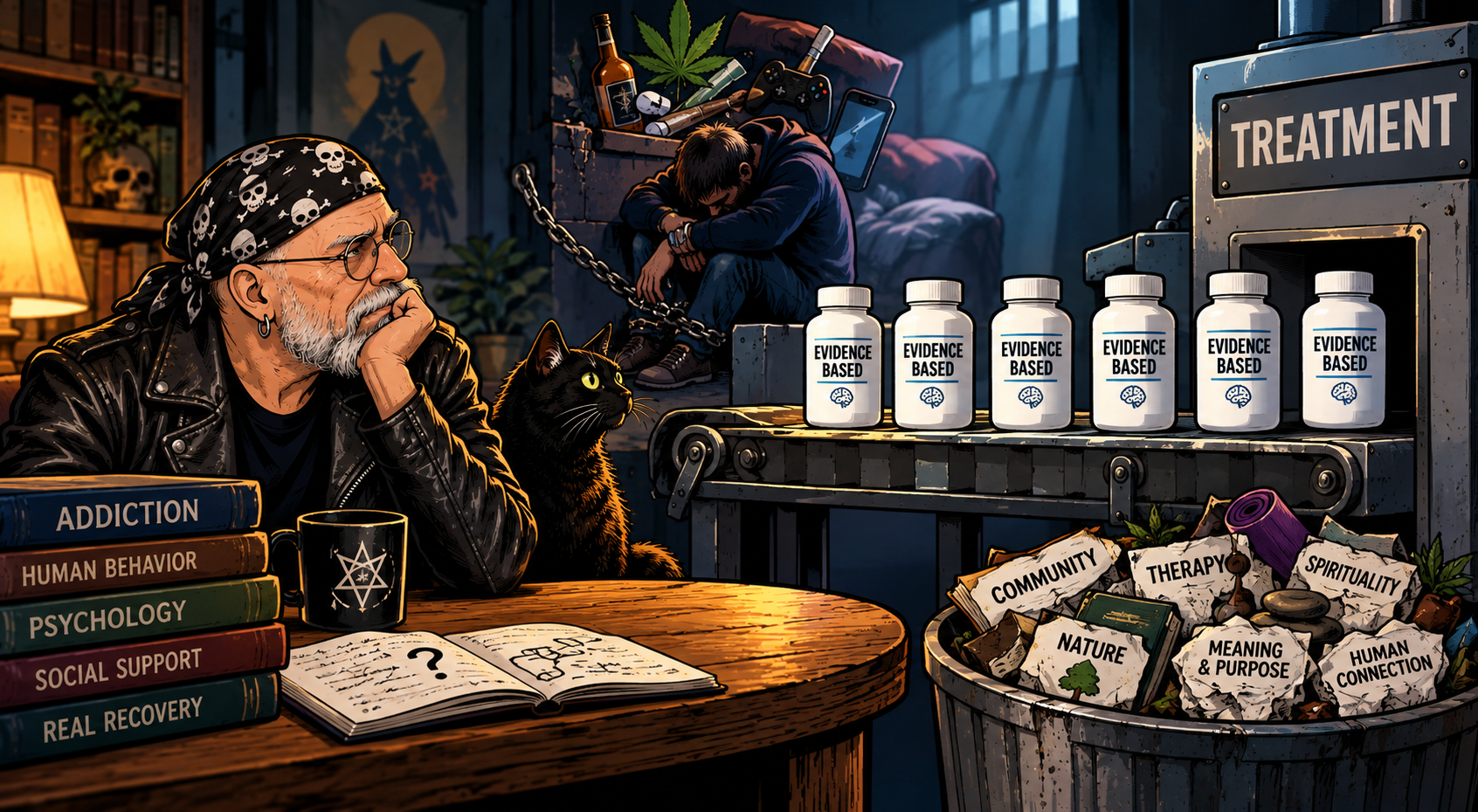
There is a particular phrase that floats through rehab brochures, grant proposals, and earnest TED-style talks, carrying with it the gentle authority of a lab coat and a reassuring nod: evidence-based treatment. It sounds comforting in the way that only science-adjacent language can, as though someone somewhere is vigilantly monitoring your recovery with a clipboard, a spreadsheet, and a statistically significant p-value—possibly while sipping herbal tea and making excellent life choices.
It implies certainty, precision, and the soothing hum of a system that has everything neatly figured out, like a Scandinavian kitchen catalog where no one has ever burned toast or cried over their own decisions.
And yet, when it comes to addiction treatment, that phrase often behaves less like a beacon of truth and more like a polite suggestion that everyone agrees not to question too loudly. It is best understood as the “recommended serving size” on a bag of chips—technically accurate, occasionally useful, and widely regarded as an interesting opening bid rather than a binding agreement.
Let us begin with the obvious, which is that addiction is messy in a way that resists tidy explanations and clean solutions. It is not a rash that can be treated with a topical cream applied twice daily until symptoms disappear without further complication or existential reflection. Instead, it is a shape-shifting and deeply human condition that involves biology, psychology, trauma, environment, habits, and the occasional existential crisis that arrives uninvited at 2:17 a.m. and refuses to leave until you have reconsidered your entire life.
Any system that claims to have pinned this down neatly with a manual and a standardized protocol deserves not blind trust, but at least a raised eyebrow and perhaps a slow, thoughtful sip of coffee while you reconsider your expectations.
When people in the field use the term “evidence-based,” what they usually mean is that a particular approach has been tested in controlled studies and has shown measurable benefits under those carefully managed conditions. This sounds excellent until you pause long enough to consider what controlled studies actually look like in practice.
Participants are carefully screened before they are allowed to take part, which means the most chaotic variables—also known as “real people having real lives”—are often minimized or excluded. Variables are managed and reduced wherever possible. The environment is structured, predictable, and intentionally simplified to the point that it occasionally resembles a well-organized summer camp for adults who would rather not be there.
In other words, it looks nothing like real life, where your cousin still owes you money, your boss sends messages at midnight, your car makes a noise that feels expensive, and your favorite bar is located two blocks away and remains emotionally available at all times.
Cognitive Behavioral Therapy (CBT), frequently presented as a gold standard, is a useful example of this dynamic. It helps people identify and change unhelpful thought patterns, which is undeniably valuable and often genuinely helpful in practice. At the same time, it can feel a bit like handing someone a beautifully designed umbrella during a hurricane and confidently informing them that they are now weather-resistant, which is technically true in a limited and highly optimistic sense.
Is it helpful? Yes, absolutely. Is it sufficient on its own? Not always, and sometimes not even close, especially when the “weather” includes stress, trauma, and a group chat that refuses to die.
Then there is the matter of how success is measured, which introduces another layer of complexity that is often glossed over in polite conversation. In addiction treatment, outcomes are frequently defined in terms of abstinence rates over a specific period of time, such as thirty days, ninety days, or, if everyone is feeling particularly ambitious and well-rested, a full year.
This is roughly equivalent to declaring a gym membership wildly successful because you showed up consistently in January, bought new shoes, and briefly considered becoming the kind of person who enjoys kale smoothies, without asking too many questions about what happened in March when it was snowing sideways and your motivation quietly relocated to Florida without leaving a forwarding address.
Relapse, within this framework, is often treated as a kind of scandal or personal failure that no one wants to discuss openly, like forgetting someone’s name immediately after they told it to you. It becomes an unexpected plot twist that disrupts the narrative of progress and makes everyone slightly uncomfortable.
However, if you take the time to look at the data itself, relapse rates for substance use disorders are actually comparable to those seen in other chronic conditions such as hypertension or diabetes, which are rarely accompanied by moral judgment or disappointed sighs.
Imagine, for a moment, if your doctor reacted to a spike in your blood pressure after a stressful month by scolding you and questioning your commitment to the treatment plan while slowly shaking their head.
“Well, clearly you did not believe strongly enough in the evidence-based nature of this medication,” they might say, which would be both absurd and an excellent way to find a new doctor.
And yet, in addiction treatment, we often perform a version of exactly that interaction, just with slightly better lighting and more pamphlets.
This is where the myth begins to reveal itself more clearly, because “evidence-based” starts to function less as a neutral descriptor and more as a protective shield. It signals legitimacy to outsiders, reassures funders that their money is being spent responsibly, and quiets skeptics who might otherwise ask uncomfortable but necessary questions.
It gives programs a kind of scientific halo, even when the day-to-day reality inside those programs often involves underpaid staff, overworked counselors, broken vending machines, and a rotating cast of human beings who are trying very hard to heal in a system that is not always built for nuance or, frankly, adequate snacks.
To be clear, the problem is not that evidence itself is flawed or unnecessary, because evidence is essential and often lifesaving. Evidence is, after all, how we collectively decided to move away from prescribing leeches for emotional distress and toward treatments that have at least some basis in reality and fewer medieval overtones.
The real issue lies in the leap from “this approach has some supporting data” to “this approach is the correct and sufficient solution for a wildly complex human problem that has been developing for years, if not decades.”
Addiction does not occur in isolation, and recovery does not happen in isolation either, no matter how many inspirational posters suggest otherwise. Factors such as social support, housing stability, employment opportunities, mental health care, community connection, and a sense of meaning all play enormous and often decisive roles in whether someone is able to sustain recovery over time.
You can have the most evidence-based therapy in the world, delivered by a kind and competent professional in a nicely lit office, but if you leave treatment only to return to the exact same environment that helped fuel the addiction in the first place, you are essentially being asked to swim upstream while someone on the shore offers encouragement in the form of a motivational quote printed in a tasteful font.
There is also the persistent issue of personalization, which is difficult to address within systems that prioritize efficiency and standardization over individuality. Evidence-based treatments are, by design, based on averages, which means they tell us what tends to work for groups of people under specific conditions.
However, no one wakes up in the morning thinking, “Today I feel particularly average, and I would like to be treated accordingly, preferably with a standardized protocol and a clipboard.”
Individuals vary widely, and what works beautifully for one person may feel irrelevant, ineffective, or even counterproductive for another, which is inconvenient for systems that prefer consistency but extremely relevant for actual human beings.
Despite this, the system often insists on standardization through manuals, protocols, and checklists that are efficient, billable, and easy to replicate at scale, which makes them very attractive to organizations and slightly less appealing to anyone with a personality.
The result is something that is about as tailored as a one-size-fits-all hat, which technically fits everyone but does not fit anyone particularly well and occasionally gives people a headache.
Humor aside, there is a real and meaningful cost to clinging too tightly to this myth. When people do not respond to treatments labeled as “evidence-based,” they often internalize that outcome as a personal failure rather than considering the possibility that the approach itself may not have been the right fit for them at that particular moment in their lives.
This is similar to blaming yourself for not enjoying a meal that you are allergic to, which is both unfair and an excellent way to miss the actual problem entirely.
So what is the alternative? It is not to abandon evidence altogether, because that would be reckless, counterproductive, and likely to reintroduce leeches in ways that no one is asking for. Instead, it is to put evidence in its proper place, where it can inform decisions without dictating them and guide conversations without prematurely ending them.
Evidence should be one tool among many, not a magic incantation that we repeat until everyone feels reassured and slightly hypnotized.
A more honest and effective approach to addiction treatment would acknowledge uncertainty rather than pretending it does not exist, which would already be a refreshing change of pace. It would emphasize flexibility over rigid adherence to protocol. It would treat relapse as useful data rather than as a source of shame or awkward silence.
It would invest as much in social and environmental supports as it does in therapeutic techniques, recognizing that context often matters as much as method, if not more.
Most importantly, it would center the individual rather than the system, the protocol, or the branding language that makes brochures look authoritative and faintly intimidating.
Because at the end of the day, “evidence-based” does not get sober.
People do.
And people, inconveniently for anyone who prefers clean data, tidy narratives, and perfectly formatted spreadsheets, are not nearly as predictable or as orderly as the charts would prefer them to be, no matter how many colors are used.
Which, if you think about it carefully enough, is probably the most evidence-based observation of all.
Cite this
Sapere Aude. “The Myth of “Evidence-Based” Addiction Treatment.” Mere Thelema, October 30, 2026. https://www.merethelema.com/essays/myth-evidence-based-addiction-treatment.
Preparing to share…
About the author