There is a moment in ritual when the form begins to answer back.
At first, one learns the words. One learns the gestures, the order of the quarters, the names, the signs, the correct inflection of command. The magician is concerned with accuracy, and rightly so. Ritual is a craft before it is an art. A rite badly learned is like a badly tuned instrument: it may make noise, but the current does not sing clearly through it.
But then, after repetition, something else can happen. The ritual ceases to feel like an object being performed and begins to behave like a living current moving through the body. The hands are no longer merely placed; they are drawn. The turns are no longer simply executed; they are followed. The breath begins to obey a rhythm older than one’s intention. The magician and witch discovers, with some surprise, that the ritual has a life of its own.
This was my first real encounter with what I came to call the chi of the ritual.
I use the word chi here carefully, not as an ornamental borrowing, but as the closest available term for the felt current of vitality that can move through a magical form once that form has become embodied. It is not the “energy” of vague occult speech, nor is it simply emotion, enthusiasm, or autosuggestion. It is more like a living pressure within the ritual body: a current that moves through gesture, breath, balance, attention, and the subtle intelligence of the flesh.
For me, this discovery came through repeated work with Crowley’s Star Ruby, Liber XXV.
The Star Ruby as Seed-Crystal
The Star Ruby began for us as a ritual of structure: a Thelemic pentagram rite, elegant, severe, and charged with Crowley’s characteristic genius for compression. It offered the signs of N.O.X., the cry of banishing, the god-names, the Thelemic cross of force and orientation. It was clear enough to learn, powerful enough to respect, and spare enough to leave room for this witch’s own nervous system to become involved.
At first we worked it as one might expect: as a banishing, a circle-casting, a way of clearing and defining the field. But the more we performed it, the more it began to behave as something other than a formal preliminary. The rite did not merely clear space; it opened space. It did not simply banish; it exposed. It did not only establish the magician at the centre of a purified field; it began to draw the ritualist into a deeper psychic geography.
The Star Ruby became, in my practice, a seed-crystal.
A seed-crystal is not the whole formation, but it determines the pattern by which the formation may grow. Drop it into the right solution, and around it something begins to precipitate. So it was with Liber XXV. Its Thelemic skeleton remained unmistakable, but something in repeated embodied work began to crystallise around it: trance, movement, atavistic resurgence, dream, and direct encounter with the hidden life of the psyche.
This emergent current became the NOX ritual.
I do not mean that NOX “improved” the Star Ruby, nor that it replaced it. Such claims would misunderstand both the origin and the dignity of the work. The Star Ruby remains what it is: a Thelemic rite of extraordinary density and force. NOX is what happened when that rite, in the hands and bodies of witches working in coven, began to move beyond its original function and reveal another possible body.
There is a difference between altering a ritual text because one is bored, careless, or eager to personalise what has not yet been understood, and allowing a ritual current to disclose, through long practice, what else it may become. The first is mere tinkering.
The second is a species of magical listening.
The Chi of Liber XXV
In the early 1980s, the small group that would become Dark Circle worked from a mixed but serious inheritance: Thelema, Golden Dawn magic, Qabalah, Witchcraft, trance practice, dreamwork, and the practical, earthy rituals of coven life. We were not trying to create a new orthodoxy. We were trying to discover which ritual forms could carry real psychic voltage.
The Star Ruby answered.
Or rather, something answered through it.
The familiar gestures began to lengthen and flow. The mudrā became less like fixed signs held in sequence and more like movements in a current. The ritual body began to behave almost as if it knew things the conscious mind had not planned. Hands were pulled into postures. Breath deepened of its own accord. The whirling sema dances acquired a kind of torque. One could feel, in the body, the rite’s appetite for motion.
This is what I mean by the chi of Liber XXV: the moment at which the ritual ceases to be only an arrangement of words and signs and becomes a current of embodied intelligence.
The Signs of N.O.X. as Psychic Gates
In that current, the signs of N.O.X. began to open not only as Thelemic formulae but as psychic gates. Therion, Babalon, Nuit and Hadit ceased to be merely names within a ritual structure and began to operate as archetypal powers. They were not abstractions. They moved through the body and imagination: beast-force, erotic dissolution, starry vastness, the hidden point of Will.
Therion came as the return of the animal body: not the animal as mindless beast, but the instinctual animal powers as incarnate truth. The Beast was muscle, hoof, breath, hunger, and the courage to be alive in flesh. In trance, this sometimes appeared as atavistic resurgence: a reaching back into older strata of being, where ritualists found themselves moving, sounding, or perceiving through animal forms.
Babalon came as ecstasy, but not the decorative ecstasy of occult romance. She came as the cup that receives shame, desire, grief, blood, laughter, and devotion in the same vessel. Her current moved through the places where the body had been exiled from holiness. She was not merely “sexual” in the reduced modern sense. She was the peril and splendour of incarnation opened to the sacred.
Nuit came as vastness. Those who have met her in ritual will know the peculiar vertigo of that encounter: the self suddenly small, not humiliated but relativised, held in a field so immense that ordinary identity becomes transparent. Nuit is the cosmic sky of the rite, but also the field in which every life, dream, terror and star appears.
Hadit came as the point within. Not ego, though the ego can imitate him badly; not ambition, though ambition often mistakes itself for Will. Hadit is the hidden spark, the secret centre, the hard bright impulse of direction in the heart of every star. Where Nuit opens the field, Hadit makes the path possible.
These four powers were already latent in the Thelemic material. What changed in the NOX rite was their mode of encounter. They became not only invoked forms, but lived presences within a trance structure.
And Then Came Anubis
And then came Anubis.
This is perhaps the clearest difference between the original Star Ruby and the NOX current as it unfolded in Dark Circle. Anubis was not imported as an exotic Egyptian decoration. He appeared because the rite required a guide. Once the ritual began to function not only as a banishing but as a night soul-journey, the presence of a psychopomp became unavoidable.
The desert was already there. The underworld was already there. The sense of crossing from ordinary consciousness into a deeper psychic reality was already there. Who, then, walks the ridge? Who watches the threshold? Who knows how to bring the soul back?
Anubis emerged as the fifth archetype of NOX: not another quarter-power, but the centre. He is the jackal at the edge of the firelight, the guide of souls through the Duat, the guardian of the necropolis, the one who knows the pathways between worlds. In the ritual logic of NOX, Anubis conducts the Seeker through the four great currents. He does not replace Therion, Babalon, Nuit or Hadit; he opens the ways between them.
Without Anubis, the journey risks becoming intensity without orientation. With Anubis, descent becomes passage.
This was not a theoretical decision. It arose from experience. The jackal appeared in the desert vision. The psychopomp function became necessary in the actual holding of the rite. Someone had to lead the meditation, speak the vision, time the build and release of the trance-dance, watch the circle, and sense when the work had ripened and when it was time to return. The human facilitator wore the mask of Anubis because the work itself had produced the need for that mask.
Occult Darshan: When the Hidden World Looks Back
Here we arrive at another important term in my vocabulary of NOX: occult darshan. By occult darshan I mean a direct, personal encounter with the hidden psychic reality that leaves a mark on the soul. It is not merely “having a vision,” still less “getting spaced out” in ritual. It is the kind of encounter that rearranges one’s understanding, alters the drift of a life, and continues to unfold through dreams, synchronicities, images, and decisions long after the rite is over.
The word darshan carries the sense of seeing and being seen. In devotional contexts it refers to the auspicious encounter with the holy, in which one does not simply look upon the deity but receives the gaze of the deity. In the NOX ritual, I use the phrase occult darshan for those encounters in which the hidden world looks back.
One may go into the rite seeking an experience and emerge having been addressed.
This distinction is crucial. In much contemporary occultism, experience is treated as a commodity: visions, phenomena, powers, confirmations. But genuine occult darshan is not collected; it is undergone. It does not necessarily flatter the magician. Sometimes it clarifies. Sometimes it wounds with precision. It may remove a cherished self-image. It places in the hands of the practitioner an image or phrase that will require years of work to understand.
In my own practice, NOX became a kind of trigger command for such encounters. That language may sound modern, even technological, but it is accurate. The ritual acted like a command sequence entered into the deep psyche. Once the pattern was set—pantacle, mantra, vision, signs, movement, drum, trance—the system opened. The psychic reality responded. Not always in the same way, and not always dramatically, but with enough consistency to show that the rite had become a working door.
Some of the doors opened onto archetypal initiation. I underwent an experience in which the great powers of the rite—Therion, Babalon, Nuit and Hadit—were not contemplated as symbols but encountered as stages of passage. Other doors opened onto systems of magical work that later took distinct form, including my Dark Tarot as a ritual and initiatory method. Still others opened onto past-life sequences, dream encounters, and varieties of personal gnosis that did not fit neatly into inherited categories.
I am not asking the reader to accept these experiences as doctrine. On the contrary, one of the disciplines of this work is not to convert personal gnosis too quickly into universal law. The experience must be honoured, tested, recorded, reflected upon, and allowed to mature. A vision is not yet a philosophy. A trance is not yet an attainment. A powerful night is not yet wisdom.
But neither should such experiences be dismissed merely because they arise through a transformed ritual current rather than through an approved institutional channel.
The Question of Thelemic Orthodoxy
This brings us to the likely Thelemic objection.
There will always be those who hear that a rite derived from the Star Ruby has been altered, extended, witch-worked, and given a new name, and who immediately suspect dilution or violation. The concern is not always trivial. Thelemic texts and rituals are not casual material. Crowley’s corpus has its own internal distinctions, including writings treated as received or inspired in a special sense, and others presented as instruction, commentary, ritual technology, or practical method. A serious practitioner should not treat all of it as raw material for personal collage.
I share that concern to a point.
There is a vulgar form of magical eclecticism that mistakes proximity for understanding. It takes a god-name here, a mudrā there, a phrase from a holy book, a gesture from a mystery school, a drum from another culture, and imagines that assembly is the same thing as initiation. It is not. A rite assembled from fragments may have no soul at all.
But there is another form of transformation that belongs to the history of magick itself. Ritual forms migrate, mutate, receive commentary, enter new bodies, and disclose new potentials under changed conditions. The pentagram ritual did not begin with the Star Ruby. The Star Ruby itself is a reworking: Crowley’s Thelemic transformation of earlier ritual technology. To treat Crowley only as a terminus, never as an initiator of further experiment, is to misunderstand something essential about the magical temperament of his work.
The question is not simply, “May one alter a Crowley ritual?”
The better question is: “Has the magician or witch actually worked the rite deeply enough to know what is being altered, what is being preserved, and what current is asking to move?”
In the case of NOX, the Star Ruby was not discarded. Its bones remain. The signs of N.O.X. remain central. The cry of banishing, the Thelemic cross and current, the orientation around Therion, Babalon, Nuit and Hadit, the plunge into the Night of Pan: these are not incidental. They are the seed-forms from which the later rite grew.
But the seed did grow.
In coven practice, the rite entered the body of Witchcraft. It was danced. It was drummed. It was held in circle. It was tested in retreats and dark rooms, in private work and group trance, in dreams and reflective meditation. It was not merely interpreted; it was lived. Over time, the ritual current took on a distinct mythic habitat: the desert at night, the oasis circle, the pantacle as waterhole and gate, the Seeker approaching the camp, Anubis prowling the precincts of circle. This is not a rejection of Thelema. It is a witch-worked continuation of ritual experiment under the signs of N.O.X.
The Night of Pan in the Body
The Night of Pan is itself not a polite state. It is not the tidy preservation of an egoic boundary. In Thelemic language, N.O.X. points toward the dissolution of the separate self in the All, toward that initiatory condition in which the small defended “I” is undone by something immeasurably larger. Pan is not merely the goat-god of rustic amusement. He is the All: nature, terror, lust, laughter, death, begetting, and the unbearable fact that life exceeds the categories by which we manage it.
To stand at the edge of the Night of Pan is to stand between panic and Pan-ic: between the ego’s fear of dissolution and the expansive, dangerous joy of being flooded by the All.
NOX, as I have worked it, courts that edge in a held form. It does not claim to confer the formal attainments of the A∴A∴ system, nor to simulate the grade of Master of the Temple. Such claims would be absurd. Rather, it creates a ritual crucible in which witches and magicians may rehearse, in body and psyche, the surrender of narrow identity to a wider field of soul.
The trance-dance is essential here.
A purely mental approach to N.O.X. risks becoming elegant metaphysics. One may discourse on Nuit, Hadit, Babalon, Therion, the Abyss, and the formula of 210 while the body remains safely defended. But the body has its own gates. Spin in the sema-dance long enough, breathe deeply enough, allow the drum to enter the feet and spine, and the carefully curated self begins to loosen. The magician is no longer merely thinking the formula; the formula is moving through blood, balance, sweat and breath.
This is why, in NOX, the dance is not spectacle. It is method.
The whirling practice, the Zaar-inspired drumming pulse, the mantra OMPEHDA, the pantacle at the centre, the vision of the desert—these together create a ritual technology of descent and return. The aim is not to become lost in trance, but to enter deeply enough that something real may be encountered and then brought back. The return matters as much as the descent. Without return, there is no integration; without integration, there is no soul-making.
A ritual that moves must also know how to close.
This, too, is part of Anubis’s function. The psychopomp does not merely open the gate. He brings the soul home. In group work, this is practical as much as mystical: watching the circle, grounding the participants, allowing darshan, encouraging dreamwork and reflection. In solitary work, it requires the practitioner to cultivate an inner Anubis: a witness-presence capable of entering the night without abandoning discernment.
The magical life is full of thresholds, and not all of them are safe merely because they are sacred. The work of the psychopomp is to know the difference between ordeal and harm, between intensity and inflation, between surrender and collapse.
Thelema, Witchcraft, and the Living Current
This is where I think Thelema and Witchcraft have much to offer one another. Thelema brings the severity of formula, the precision of Will, the high voltage of symbolic compression, the terrible beauty of the Great Work. Witchcraft brings the circle, the body, the land, the seasonal and the ancestral, the willingness to let power move through flesh, drum, breath and relationship. The NOX ritual stands at the crossing of these streams. It does not resolve their differences by flattening them. It lets them generate current.
A Thelemite may ask: is this still the Star Ruby?
No. Not if by “the Star Ruby” we mean Liber XXV preserved in its textual and ritual specificity.
But perhaps that is not the only question.
A more fruitful question might be: what did the Star Ruby make possible here? What did it seed? What happens when its signs of N.O.X. are not only performed, but followed into the dark? What occurs when the magician allows the ritual to become a living current rather than a closed artefact?
For me, the answer was NOX: a night soul-journey born from Thelemic ritual technology, transformed through coven-based Witchcraft, and deepened by trance, dream, Anubis, and occult darshan.
When the Rite Becomes a Path
One may preserve a ritual text. One may also preserve a ritual current. These are related but not identical tasks. The first requires fidelity to form. The second requires fidelity to life. The difficulty, and the art, is knowing which task one is undertaking at any given moment.
I would not hand the NOX rite to a beginner as a replacement for learning the Star Ruby.
Learn the rite. Respect the bones. Know the source. Let the original do its work. But if, after long practice, the ritual begins to move—if the hands are pulled, the breath changes, the godforms cease to behave like concepts, and the desert opens under the feet—then the magician has another responsibility.
Listen, and not obey blindly. Not inflate the experience into a revelation for all humanity. Not rush to found a new church around one’s nervous system. But listen with discipline, with humour, with record-keeping, with the willingness to test and return.
The living Work has always required this.
When the ritual begins to move, it is no longer enough to ask whether one has performed it correctly. One must ask what has awakened within it, and within oneself, and what kind of life is now required in response.
Under the Night of Pan, the safe little house of the ego does not remain intact. The door blows open. Something with horns is laughing in the dark. A jackal waits at the edge of the firelight with eyes that pierce the night dreaming. The stars of Nuit lean closer to embrace the soul. The body begins to move, turn and spin in the spiralling sema-dance. The mantra rises and calls to the great archetypes of night. The rite, which began as a text, becomes a path the Fool dances along.
The NOX ritual is not a rejection of Thelema. It is one witch’s long obedience to a Thelemic ritual current that refused to remain still. It is the Star Ruby followed into the body, into the coven, into the desert, into dream. It is a continuation of experiment beneath the old and terrible sky of N.O.X., where Pan is the All, Anubis opens the way, and the Work is proven not by preservation alone, but by what comes alive when the ritual begins to move.
A First Practicum: The Black Disc and the Word of Night
If this essay has stirred something in you — whether as a Thelemite, magician, witch, scholar, or curious reader of the Mysteries — I have prepared a short companion workbook to take the next step from written reflection into applied practice.
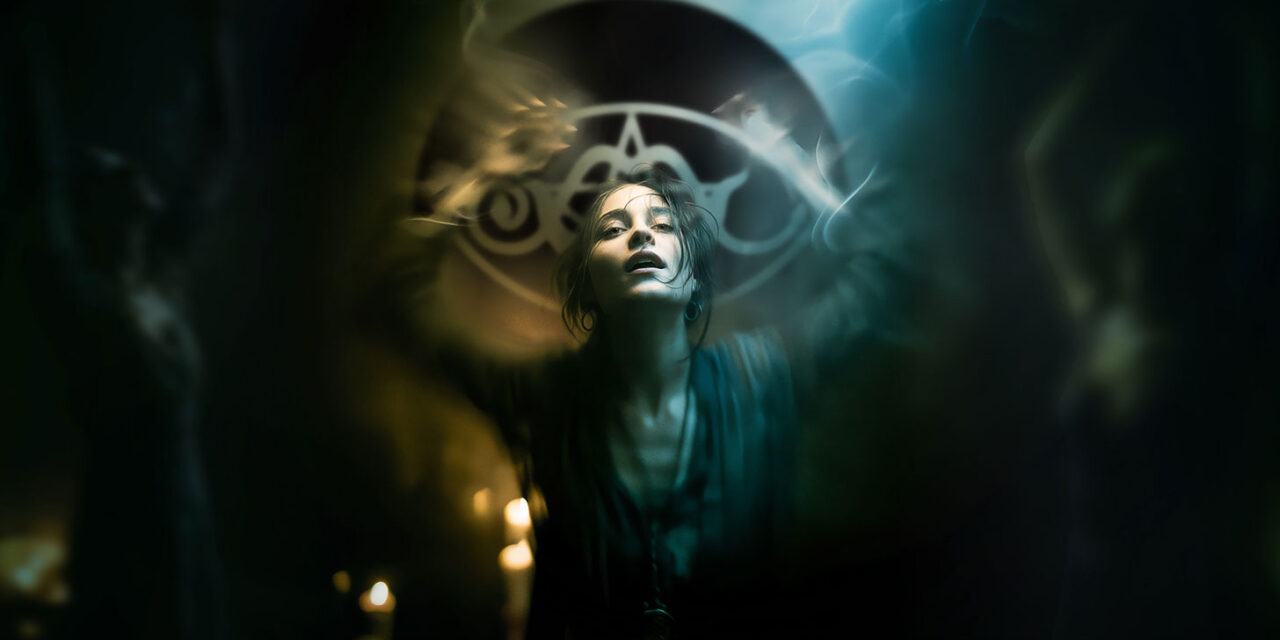
The Black Disc and the Word of Night: A First Key to the NOX ritual offers a simple, contemplative introduction to two central elements of the NOX current: the Black Disc, or the NOX pantacle, and the mantra OMPEHDA, the Word of Night.
This is not the full NOX ritual, nor is it intended to replace formal study, coven work, or guided ritual practice. It is a first key: a way to sit with the symbol, sound the mantra, observe what arises, and begin to test for yourself how image, breath, word, and psyche may enter into conversation.
For those who have read this article as theory, the workbook offers a modest practicum.
For those already engaged in Magick, it offers a doorway into the living question at the heart of the NOX ritual: what happens when a ritual current begins to move through the body, the breath, and the dreaming soul?
You can download the companion workbook here: The Black Disc and the Word of Night
The Black Disc is before you.
The Word of Night is in your breath. The rest is between you and the Work.
May it serve as a quiet threshold into the opus.