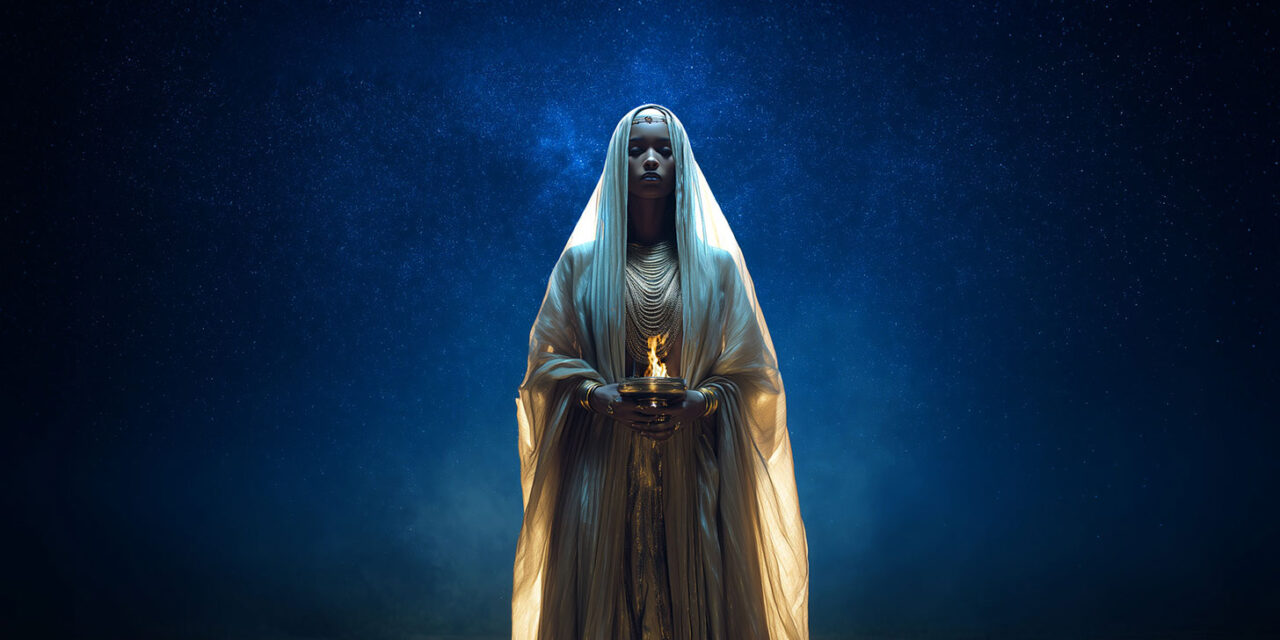
Nuit first came to me not as a Thelemic doctrine, but as Night itself: vast, erotic, maternal, and quietly terrifying.
I did not meet Her first in a lodge, nor in a formally Thelemic temple, nor through the careful architecture of ceremonial magick. I met Her through Witchcraft: through trance, full-moon rites, coven work, ecstatic invocation, and the strange way a presence can begin moving through one’s ritual life long before the conscious mind has found the proper name for it.
Only later did I recognise how strongly this presence resonated with the Thelemic figure of Nuit: the Goddess of infinite space and the infinite stars thereof, the opening voice of Liber AL vel Legis, the great starry body in whose company the Law of Thelema first announces itself.
This is not an essay written from the centre of Thelemic orthodoxy. I do not write as one claiming doctrinal custody over Crowley’s revelation, nor as a representative of any Thelemic order. I write as a contemporary Witch, a coven teacher, and a practitioner whose life has been shaped by ritual encounter. My relationship with Nuit arose through the Craft, through the body, through the Circle, and through the lived experience of the Goddess as a numinous presence.
That distinction matters.
For many Thelemites, Nuit is approached through scripture, commentary, ceremonial formula, and the inherited magical language of Aleister Crowley’s work. For some Witches, however, She arrives by another road: through the sky, through the Moon, through the psychic field of the coven, through the body opened in trance, through the ancient gesture of Drawing Down the Goddess.
These are not identical paths. They should not be collapsed into one another. Yet there is a deep and fruitful conversation to be had between them.
At the heart of that conversation is a question: what happens when Nuit ceases to be only a figure in a sacred text and becomes a living presence who penetrates and reorganises the soul?
The Night Before the Name
In 1999 I named my coven Nuit’s Veil. The name was not chosen as an ornamental borrowing from Egyptology or Thelema. It was the recognition of a current that had already been moving through my work for decades.
My own encounter with Nuit began in the late 1970s during full-moon esbats. In trance, I began receiving short mantric verses — fragments of invocation, spell-song, and devotional utterance. They did not arrive as polished liturgy. They came as charged phrases, repeated inwardly, pressing for expression. Over time they gathered themselves into a ritual form and entered the heart of our coven’s Drawing Down the Moon practice.
At the time, I did not think of this primarily in Thelemic terms. I was a Witch working ritually with the Goddess. Yet the presence that came through those rites was not merely lunar in the gentle or folkloric sense. She was vast. She was stellar. She was not only the Moon above the Circle, but the Night through which Moon, stars, body, psyche, and fate were held.
In later years, as I deepened my engagement with Thelemic material, the connection became unavoidable. Nuit, the ancient Egyptian sky goddess, had reappeared in Thelema not as a museum-piece deity but as the living body of infinite space. In Liber AL, She speaks not only as the canopy of heaven but as the ecstatic field in which every star-being discovers its own nature.
For a Witch, this is immediately recognisable. Not because Witchcraft and Thelema are the same thing, but because both are concerned with lived encounter: with power, transformation, desire, initiation, and the difficult work of becoming more fully oneself.
The Witch does not need to become a Thelemite to hear Nuit’s voice. But the Witch who has heard Her may find that Thelema has preserved a language for some of what was encountered in the dark.
Nuit as Goddess, Archetype, and Presence
One of the difficulties in speaking about Nuit is that every available category is both useful and insufficient.
Historically, Nuit belongs to ancient Egyptian religion. She is the sky goddess whose arched, star-strewn body bends over the earth. She swallows the sun at dusk and gives birth to it again at dawn. She is roof, womb, horizon, and mystery. The dead pass into Her keeping. The solar journey through night unfolds within Her body.
Thelemically, Nuit is more than an Egyptian goddess imported into a new system. She becomes the infinite field of manifestation itself: the limitless expanse in which every man and every woman is a star. In that vision, divinity is not merely above the world; it is the ecstatic space in which all beings move according to their true nature.
Psychologically, Nuit may be approached as an archetype of the great containing field: the vast matrix of psyche and cosmos in which the ego discovers both its smallness and its dignity. In Jungian terms, She resembles the Self in its encompassing, transpersonal aspect — not the ego’s self-image, but the greater totality that holds shadow, desire, vocation, death, and transformation.
But even this is not enough.
A deity is not exhausted by history. A goddess is not reduced by psychology. An archetype is not a metaphor one can safely file away after a clever interpretation. When such a figure becomes active in ritual, She is encountered as presence. Something looks back.
This is what I have elsewhere called occult darshan: the reciprocal gaze between practitioner and numinous power. In Hindu usage, darshan suggests seeing and being seen by the deity. In occult practice, something similar occurs when an invoked form ceases to feel like an image projected by the mind and becomes a living centre of awareness within the ritual field.
One may interpret that experience in several ways. A Jungian might say the archetype has constellated. A magician might say the god-form has been contacted. A devotee might say the Goddess has come. These are different languages, not necessarily mutually exclusive realities.
The important point is that such an encounter changes the practitioner.
Nuit, when experienced in this way, does not merely comfort. She expands. She eroticises existence in the deepest sense: not simply by invoking sexuality, though She certainly does not fear it, but by awakening the desirous bond between self and cosmos. She invites surrender, but not collapse. She opens the soul into vastness, but also asks it to become a star.
That is not a small demand.
The Witch’s Circle as Star-Field
Coven-based Witchcraft gives Nuit a natural vessel.
A real Circle is not merely a room in which ritual happens. It is a charged field, a boundary, a psychic container. At its best, the coven Circle functions as a temenos: a sacred precinct in which ordinary identity softens and deeper forces can safely constellate. The Circle contains and intensifies. It allows the archetypal world to draw nearer without overwhelming the practitioner.
When Nuit is invoked within such a space, the Circle becomes more than a lunar grove or elemental enclosure. It becomes a star-field.
This is where Thelema and Witchcraft can speak to one another with unusual intimacy. The Thelemic proclamation that every man and every woman is a star is not merely a metaphysical slogan. In ritual space, it can become a felt reality. Each person in the Circle carries a point of flame, a distinct centre of experience, desire, Will, wound, history, and possibility. The coven, when properly held, does not erase those differences. It reveals them.
Here, Nuit is not only above the Circle. She is the field in which the Circle exists. She is the space that permits each star to shine without needing to devour the others.
This is one of the most important ethical implications of Her mystery.
If every person is a star, then spiritual community cannot be built upon possession, domination, glamour, or the swallowing of individual Will into the personality of a leader. A coven under Nuit must learn the difference between union and fusion. It must allow intimacy without psychic trespass, devotion without servility, initiation without coercion.
The same is true in Thelemic communities. “Do what thou wilt” (AL 1:40) cannot mature if it remains trapped in adolescent self-assertion. True Will does not excuse the ego from relationship; it deepens accountability to the pattern of one’s being. “Love under will” is not sentimental softness. It is disciplined relation.
Nuit’s starry body therefore offers both ecstasy, guidance and correction. She grants a vision of infinite freedom, but that freedom is cosmic, not merely personal. Stars have orbits. They move in relation. They shine, but they also belong to a vast order.
The Witch’s Circle, when understood this way, becomes a small training-ground in stellar ethics.
Hadit, the Point Within
If Nuit is infinite space, Hadit is the point within.
This polarity is one of the great gifts of Thelemic symbolism. For the Witch approaching Thelema from outside its formal structures, Hadit may initially feel less familiar than Nuit. Witches often have an immediate relationship with the Goddess of night, moon, earth, and body. Hadit, by contrast, is interior fire: the secret centre, the hidden flame, the irreducible point of consciousness.
Yet this polarity is deeply useful.
In Witchcraft, we often speak of the Goddess and God, Moon and Sun, womb and seed, darkness and horned vitality. These are not identical to Nuit and Hadit, but there are resonances. Nuit gives the infinite field. Hadit gives the point of experience. Nuit is the vastness in which becoming occurs. Hadit is the burning centre from which one says: I am here.
Psychologically, the relationship between Nuit and Hadit can be read as the relationship between the encompassing Self and the awakened centre of individual consciousness. The ego, when inflated, imagines itself to be the whole cosmos. When crushed, it imagines itself to be nothing. Hadit offers another possibility: the ego aligned with its inmost flame, neither tyrant nor victim, but point of contact.
This matters profoundly in magical practice.
Many mystical systems emphasise dissolution. The practitioner falls into the ocean, disappears into the divine, or rests in the ground of being. Such experiences can be real and necessary. But Thelema, at least as I understand it from my Witch’s vantage, does not stop there. The star must not merely dissolve into Nuit; it must discover its own orbit within Her.
That is the movement from mystical absorption to magical responsibility.
The Witch who falls into the body of Nuit must return. The one who receives the vastness must then cook dinner, answer emails, hold the Circle, repair harm, speak truth, write the book, leave the dead relationship, begin the work, or refuse the false calling. The night-sky experience must eventually become life.
This is why Nuit is not only consoling. She initiates.
Initiation Beneath the Night Sky
Initiation is too often reduced to membership, degree, lineage, or ritual admission. These may have value within particular traditions, but they are not the whole of initiation. At its deepest, initiation is a reorganisation of being. It is the encounter that changes the terms by which one lives.
Nuit initiates by vastness.
She reveals the insufficiency of the cramped life. She shows the practitioner that identity is not the same as destiny, that fear is not the same as caution, that social compliance is not the same as Will. Her night-sky body relativises the ego without humiliating it. Under Her stars, one becomes smaller and more significant at the same time.
That paradox is central.
The ego hates being displaced from the centre of the universe. But the soul, if I may use that old and unfashionably useful word, longs to belong to something larger than its anxieties. Nuit answers that longing, not by removing individuality, but by placing it in a field of meaning.
This can be ecstatic. It can also be destabilising.
An authentic encounter with Nuit may bring dreams, erotic awakenings, grief, creative urgency, psychic openings, or a painful recognition that one has been living beneath the scale of one’s own star. She may arrive as beauty, but the beauty is not decorative. It exposes. It draws forth. It asks: what would your life look like if you stopped pretending to be less than you are?
This question belongs as much to Thelema as to Witchcraft.
True Will is not discovered by whim. Nor is it imposed by doctrine. It emerges through contact, ordeal, attention, and disciplined listening. In my experience, Nuit’s presence assists this process by giving the practitioner space enough to hear what the ego usually drowns out.
In coven work, this may happen collectively. A Circle under Nuit can become a vessel in which members begin to sense not only personal desire, but spiritual trajectory. People discover gifts. Shadows surface. Projections intensify. The group itself may become a starry body, each member revealing where the others are bright, wounded, evasive, hungry, afraid, or called.
This is beautiful work. It is also dangerous if poorly held.
The night sky is vast, but the coven still needs agreements, ethics, and grounded practice. No archetype excuses bad behaviour. No goddess abolishes discernment. Nuit does not require us to become vague, boundaryless, or intoxicated with our own spiritual theatre. The deeper the contact, the cleaner the vessel must be.
That, too, is Love under Will.
A Witch at the Edge of the Thelemic Temple
I am aware that some Thelemites may find a Witch’s approach to Nuit too syncretic, too psychological, too devotional, or insufficiently anchored in Crowley’s technical system. That is fair. Traditions have their own disciplines, and Thelema deserves to be understood on its own terms.
But I would also gently suggest that no living current belongs only to its commentators.
Nuit is not made real by quotation alone. Nor is She confined to the ritual habits of those who know the correct attributions. Sacred texts matter. Lineages matter. Technical magical training matters. But if Thelema is truly a Law of life, then it must be capable of speaking beyond the boundaries of those already fluent in its inherited forms.
A Witch may meet Nuit differently.
She may meet Her outdoors, lying beneath the southern stars. She may meet Her in the raised power of a full-moon Circle. She may meet Her in trance, in the body of a priestess, in the silence after chant, in the terrible tenderness of a life suddenly seen from the viewpoint of eternity. She may not use Thelemic language at first. She may not quote Liber AL. But the encounter may still be recognisably of Nuit.
This does not make Witchcraft secretly Thelema. Nor does it make Thelema merely a form of Witchcraft in ceremonial robes, or dancing skyclad. The distinction is worth preserving.
Thelema carries a particular revelation, scripture, magical system, and historical burden. Modern Witchcraft carries its own mythic structures, seasonal rites, coven mysteries, folk inheritances, and hard-won modern developments. Each path has its genius. Each has its shadows. Each has produced brilliance, nonsense, sanctity, theatre, courage, vanity, and transformation — sometimes all in the same temple, which is awkward but traditional.
The more interesting question is not whether one path can claim the other, but what becomes visible when they meet honestly.
From where I stand, Nuit is one of those meeting places.
She allows Thelemites to remember that their Goddess is not only textual but cosmic, bodily, erotic, and alive. She allows Witches to recognise that the night-sky Goddess we invoke may also speak in the language of stars, Will, and infinite space. She invites both traditions to become larger without becoming less themselves.
The Body of Night and the Work of Will
For me, Nuit remains inseparable from practice.
She is not only an object of reflection. She is encountered through breath, chant, posture, incense, darkness, invocation, and the altered atmosphere of the Circle. She is present when the ordinary room becomes more than a room. She is present when the practitioner feels the body as both flesh and constellation. She is present when the ego softens enough to be instructed by immensity.
This is why I resist reducing Her to either theology or psychology.
Theology gives us language for reverence. Psychology gives us language for interior transformation. Magick gives us method. Ritual gives us the body of the experience. None of these is sufficient alone. Together they allow us to speak more truthfully about what actually happens when a god-form becomes real in practice.
And what happens, at least in my experience, is not escape from life but a more demanding intimacy with it.
To stand beneath Nuit is to feel the strange dignity of existence. One’s wounds are not erased, but they are placed in a greater field. One’s desires are not automatically sanctified, but they are taken seriously. One’s Will is not handed down as a slogan, but slowly revealed through the pressure of attention and the consequences of action.
This is where Thelema’s genius continues to matter.
“Do what thou wilt” is easily misunderstood as permission. In the presence of Nuit, it becomes vocation. It asks not, “What do I feel like doing?” but “What is the deep pattern of my being, and what life would be required to honour it?”
That question is not answered once. It is lived.
A Witch knows this through the cycles of the Moon, the seasons, the repeated Circle, the return of the same gods and powers in deeper forms. Thelema knows it through the discipline of Will, the ordeal of self-knowledge, the magical record, the confrontation with one’s own star-nature. In both, the Work is not abstraction. It is embodied. It costs something.
Nuit, in Her generosity, does not spare us that cost. She gives us space enough to become. Then She asks us to become.
Reflection: When the Goddess Looks Back
The first time Nuit becomes real, one does not necessarily understand what has happened.
There may be only a shift in atmosphere, a deepening of darkness, a sensation of falling upward into space, or the uncanny feeling that the night itself has become conscious. There may be tears, laughter, arousal, fear, silence, or nothing at all until dreams begin to change weeks later. The signs are not always theatrical. The Goddess is under no obligation to behave like a stage effect.
But when She looks back, something in the practitioner knows.
For the Thelemite, that gaze may illuminate the words of Liber AL from within. For the Witch, it may deepen the mystery of the Goddess beyond familiar lunar forms. For the serious practitioner of either path, it may open a more spacious understanding of Will, love, freedom, and responsibility.
My own life with Nuit began before I had adequate language for it. It moved through full-moon rites, coven practice, trance-song, and the founding of Nuit’s Veil coven. Thelema later gave me another way to understand the current I had already encountered. Witchcraft gave me the body through which to receive it.
I do not believe we need to resolve that tension. I believe we need to honour it.
There is a kind of knowledge that comes only from standing under the night sky long enough for the sky to cease being scenery. There is a kind of magick that begins when the symbol stops being symbolic. There is a kind of initiation that occurs when the vastness does not annihilate the self, but calls it into truer orbit.
Nuit is that vastness.
She is above us and within us. She is the body of night and the field of stars. She is the great archetype of infinite space, the ancient sky mother, the Thelemic goddess, the Witch’s midnight veil, the erotic and terrifying openness of existence itself.
To know Her is not merely to admire the night: It is to become accountable to the star one is.