Recently, Cinemark decided to release Citizen Kane for its 85th anniversary. It was only showing for a couple of days, so my partner and I went to see it. I haven’t watched the film since I was in my twenties, even though we own it, and it was really moving on the big screen in a way that I hadn’t realized before.
There is something almost embarrassingly small at the center of Citizen Kane. Not trivial, not insignificant, but certainly small in the sense that after all the marble and machinery, after the newspapers and the elections, after the opera houses and the warehouse of looted civilizations, the whole thing comes down to a boy in the snow with a sled.
That is the scandal of it. Charles Foster Kane dies in a palace built to hold the evidence of a life that could buy nearly anything, and his last word is not the name of a lover, a rival, a newspaper, a cause, or a god. He utters a single word: Rosebud.
It’s a child’s word, which almost nobody in the film can parse, and it moves through the whole apparatus of journalism and gossip and public curiosity without once being translated. The reporters want it to explain Kane, which is exactly the sort of thing reporters would want. Find the missing fact and the man becomes legible. Locate the key and the locked room opens. Get the last word and the life finally makes sense.
But the film is wiser than its reporters. Rosebud does not explain Kane. It marks the place where explanation starts to fail.
That is why it stays useful from a Thelemic angle. A lesser reading makes Kane a morality tale about ambition, or wealth, or pride—and to be fair, all of that is in there. Kane is ambitious, wealthy, proud, and often cruel, theatrical, vain, manipulative, and childish in the particular way only powerful adults can be childish. But stopping there shrinks the film to a fraction of its size.
The problem with Kane is not that he wanted too much.
Thelema is not frightened of greatness. It is not offended by force, brilliance, appetite, conquest, or the desire to leave your signature on the world. A Thelemic reading that scolds Kane for failing to be modest is a bad reading of Thelema and a really boring reading of the film. His tragedy is not that he wanted.
It is that he mistook wanting for Will.
That distinction is close to the whole matter. Will is not an impulse. It is not “whatever I feel like doing,” not the ego inflating itself to cosmic size and demanding that the universe applaud. Will is deeper and quieter than wanting. It is the law of one’s being, the proper motion of the Star—what one is, not what one lacks or craves or grabs at in the dark. Appetite can imitate it. Trauma can counterfeit it. The ego can put on its vestments and boom from the balcony. But Will cannot be performed into being.
Kane spends his life surrounded by the symbols of sovereignty and never becomes sovereign. He has power without command of himself, appetite without direction, a kingdom without a center. He can acquire, announce, build, buy, and even punish. The one thing he cannot do is become whole.
That is the irony of Kane. At a glance, he looks like solar force—immense, radiant, bending institutions around himself, walking into rooms as though history had been holding the door. He buys a newspaper and wires it into his own nervous system. He runs for office as if public life were just a bigger stage for his image. He builds Xanadu, that absurd anti-temple of possession, and pours the world into it.
Yet the light he throws is not solar. It is the light of a burning house.
The Child Taken Out of His Own Life
The primal scene of Citizen Kane is not Kane’s death. It is the moment he is taken from home.
We see him outside in the snow, in motion, alive. Not yet Kane the powerful newspaper magnate, but just a boy in a world that is small, cold, and immediate, but a world that is his alone. Inside the house, adults decide his life for him because a fortune has surfaced. A banker—Walter Thatcher—arrives as the agent of law, guardianship, and order. Kane’s mother, for reasons the film only half-discloses, sends the boy away. Thatcher will raise him, manage the estate, administer his future. Yet the boy keeps sledding until the decision made indoors reaches him outdoors.
This is a childhood wound, and yet it is more than that. In Thelemic terms, it is a break in the continuity of his Will. Kane is lifted out of the field where his nature might have unfolded on its own and set down under the supervision of abstraction: money, law, guardianship, property, inheritance, respectability. Thatcher never meets him as a soul. He meets him as a responsibility—little more than an estate, a management problem.
This does not make Thatcher a cartoon villain. One of the shrewder things the film does is refuse to let him be simply wrong about Kane. Kane does turn reckless. He does confuse freedom with opposition and power with right. Thatcher’s horror at the grown man is not only a banker recoiling from vitality; some of it is earned. But Thatcher cannot bless Kane, and that is the point. He can educate, fund, discipline, oppose, and disapprove of him. He can preserve the machinery around him. He cannot see the child as a sovereign Star.
Thatcher is Old Aeon authority in its coldest register—law without warmth, order without initiation, guardianship with no intimacy in it. He is the world of fathers and contracts, of “this is how things are done.” So Kane’s later revolt against him looks, at first, like liberation.
But rebellion is not freedom, and that may be the most Thelemic lesson in the picture. Kane spends decades opposing Thatcher. He goes out of his way to mock him, defy him, burn money in ways engineered to offend him, use inherited wealth to attack the class that raised him, cast himself as the people’s champion against the very powers that made him. But being against Thatcher is still being organized by Thatcher. Kane never escapes the old man. He only inverts him.
That is the trap, and plenty of people fall into it: they mistake inversion for initiation. They think they’ve slipped a law because they now do its opposite. But the opposite of bondage is not freedom. Sometimes it is only bondage facing the other way. Thatcher stays one of the hidden instruments Kane measures his life against. Kane wants to prove him wrong, to humiliate him, to show that the heir can become the storm. Proving something to the dead father is not True Will. It is still a conversation with the dead father. Which is why Kane’s power feels so oddly unfree. He can do nearly anything, and so much of it has the flavor of compensation. His life is not an unfolding from a center. It is an explosion outward from a wound. He builds, and the building does not heal. He collects, and the collection does not complete. He loves, and the love frees no one.
There is a boy in the snow, and then there is an empire. Both are real. The thread between them has been cut.
The Newspaper as Mirror
Kane’s move into the newspaper business is one of the film’s great temptations, because it very nearly looks like vocation.
He takes over the Inquirer and decides it will not just report the world as the respectable classes prefer it. It will fight. It will expose corruption, speak for ordinary people, offend the comfortable, and be loud, vivid, and alive. There is something admirable in that, and it would be too easy to treat all of Kane’s public life as fraud from the start. But it isn’t. Kane has real energy and real contempt for stale institutions. He has a genuine gift for theatrical communication, and the theatrical is not automatically false. Sometimes the truth needs a trumpet. Sometimes it needs a headline. Sometimes it needs someone rude enough to say out loud what polite society has agreed to bury. A Thelemic reading has to grant Kane his magnificence, or the tragedy weighs nothing.
The problem is not that he enters public life, or wants to change things, or enjoys the spectacle of influence. The problem is that the work cannot stay work. It has to become proof of Kane.
That is where the newspaper turns ambiguous. It stops being a business, or even a political instrument, and becomes an extension of Kane’s self-image. He doesn’t only want to tell the truth; he wants to be the one who tells it. He doesn’t only want to champion the people; he wants to be loved as their champion.
This, again, is the line between Will and appetite. Someone acting from Will can still be bold, disruptive, unpopular, even grandiose to look at, but the work has its own necessity. The Star moves according to its nature, and there is a kind of obedience in that, though nothing servile about it. The person serves the work because the work is the shape of their being. Kane serves it the other way around. The work exists more and more to reflect him back at enormous scale.
The newspaper becomes a mirror, and a mirror is a dangerous instrument in the hands of a wounded man. The film earns the melodrama of that image. Kane uses media to project a version of reality into the public mind—amplifying, distorting, manufacturing intimacy with strangers, confusing attention with love. None of which feels less relevant now than it did in 1941.
But the Thelemic point is not the tired one about media being manipulative. It is that Kane never finds his Word. He buys a press and manufactures one instead. In Thelemic terms, a Word is not a slogan or a brand or the noise a personality makes once it has money and distribution. It is the expression of a spiritual formula, and it carries authority because it arises from contact with something real. Kane’s words move people without being rooted in him. They build an image—Kane the reformer, Kane the politician, Kane the champion—and behind the image sits the old hunger: see me, love me, tell me the boy in the snow was not given away for nothing.
That makes his public virtue unstable. He can do good things for mixed reasons, which is part of what keeps him interesting. The film is not naïve enough to claim that selfish men never accomplish anything, and not sentimental enough to pretend public idealism launders private disorder. Kane’s idealism is real enough to move you and contaminated enough to turn destructive. He wants to serve the people, and he wants the people to serve as the audience for his self-creation.
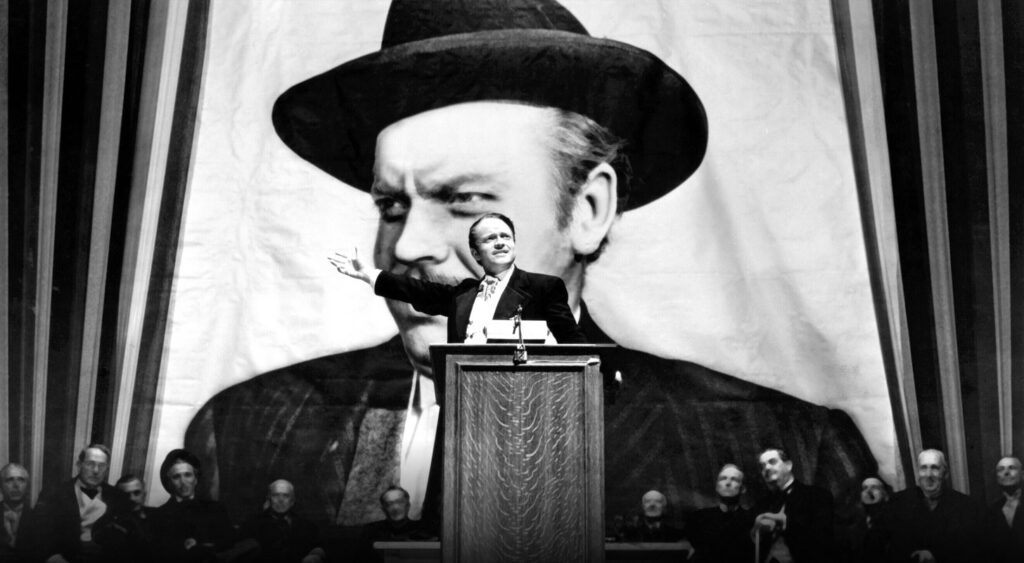
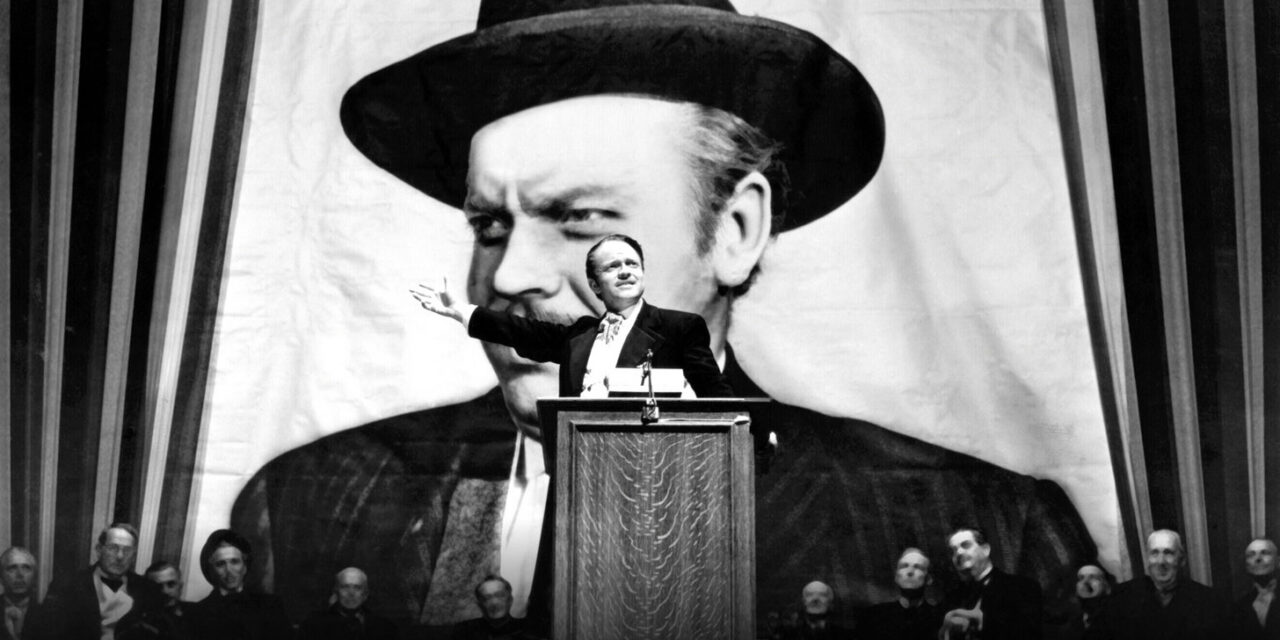
His political career collapses on cue, because the campaign was never only a campaign. It is his fantasy of public recognition raised to its highest pitch. At one point in the film, he stands in front of the enormous poster of his own face, dwarfed by the image he made of himself, and the frame tells you nearly everything. Kane never grew large enough to fill the picture. The picture grew large enough to swallow the man.
Then scandal walks in. Susan walks in. Reality walks in. And Kane cannot bear reality the moment it stops following the script. His rage is not only a man caught in his own hypocrisy. It is a magician whose spell has failed in public. And false magic always fails in the end. It can dominate for a while, dazzle, even raise institutions. It cannot make a soul.
Love, Possession, and the Other Star
The clearest evidence that Kane confused appetite with Will is not in his politics. It is in how he loves.
Thelema’s doctrine of Will can’t be separated from its doctrine of love, and both get misread constantly. “Love is the law, love under will” is not a soft cushion placed under “Do what thou wilt.” It is a discipline. Love here is not sentimental absorption, not possession, not one person collapsing into another. Love under will requires you to recognize that the other is also a Star.
Kane cannot do it. He wants love with his whole body and cannot receive it as a free act from another person. So he tries to secure it, purchase it, stage it, demand it, prove it, and finally imprison it. He hands over things instead of himself. He builds rooms instead of relationships. He offers splendor where tenderness was the assignment. He mistakes provision for intimacy and possession for union.
Nowhere is this clearer than with Susan Alexander. Susan matters enormously because she punctures the grandeur of Kane’s story. She is not a destiny figure or a goddess lowered into the plot to redeem the hero, not a secret genius waiting to be discovered. She is ordinary. She is fragile, sometimes foolish, sometimes brave, sometimes just tired, and painfully human. That ordinariness is the whole point. A lesser film would make her either worthy of Kane’s fantasy or plainly beneath it. This one lets her be a person. Not an emblem of high art, not an emblem of vulgarity, not “the second wife.” A person.
And Kane cannot stand her personhood. He decides to make her an opera singer or rather, to make her a monument to his power to confer significance. Her singing is not her Will; it is his project. Her career is not her nature unfolding; it is Kane imposing a destiny on another human being because he cannot tell his desire apart from reality.
This is about the most anti-Thelemic thing he does. Not because opera is beneath her, or because wanting greatness for your spouse is a sin, or because Susan should be spared all difficulty. Because he tries to overwrite her orbit with his own. He never asks the question love actually requires—who is this person?—and asks instead: what can I make of her? Those are very different questions.
People often file Kane’s treatment of Susan under ego, and it is that. But it is more than ego. It is a breach of cosmic courtesy. If each person is a Star, then dragging another Star into your private orbit is not love. It is tyranny in the costume of devotion—and Kane is devoted, which is the unbearable part. He is not cold with her. He wants her to be happy, or believes he does. He wants to give her everything: comfort, attention, instruction, opportunity, applause.
But everything is not love when the one thing withheld is freedom. Susan’s misery becomes intolerable because she is trapped inside Kane’s fantasy of his own generosity. He can always say, with real sincerity, that he did it all for her: the opera house, the teachers, the publicity, the machinery of her humiliation, all of it for her. And it is not for her. It is for the Kane who needs to prove his Will can bend reality, who cannot survive the thought that his chosen object might stay ordinary, who has decided love means the beloved must become evidence of his greatness.
So Susan’s leaving is one of the most genuinely Thelemic acts in the film, not because she turns heroic or uncovers some magnificent destiny. She just leaves. She refuses to go on being an object in his cosmology, refuses to keep serving as proof of his power, refuses to be consumed by the greatness of a man who cannot see her. There is dignity in that. Modest dignity, but dignity all the same. Not every act of Will looks like conquest. Sometimes it looks like walking out of a palace.
The Witnesses Who Cannot Save Him
Jerry Thompson, the reporter sent to crack the meaning of Rosebud, is easy to underrate, and the film almost dares you to. He isn’t charismatic or especially deep. He never dominates a scene; half the time he’s barely a face. He is more function than man: the investigator, the listener, moving witness to witness, trying to assemble a dead person out of fragments.
Which is exactly why he matters. Thompson is the rational, biographical, journalistic mind running straight into a mystery it can’t master. His profession believes there is a fact somewhere that explains Kane: interview the right people, read the right memoir, consult the archive, and the whole man will resolve into view. It is not a foolish belief. It is the belief that, beneath all biography, therapy, history, and confession, we want to be understood. And we understand by assembling stories, hunting for the wound, the choice, the motive, the secret shame, the lost object. The film doesn’t mock the search. It just fences it.
Thompson never learns what Rosebud means. We do; he doesn’t. That is not a clever gimmick. It is a decision about how much a life can be known. Thompson can gather testimony but cannot reach the secret name of the soul. Each memory he collects is partial and self-interested—fond, resentful, wounded; all true, but all incomplete. Thatcher sees Kane through property and discipline. Bernstein sees him through loyalty and nostalgia. Leland sees him through friendship and disappointment. Susan sees him through exhaustion. The servants see the ruins. The reporters see a story. Every one of them is right about something. None is right about the whole.
That refusal is a lot of why the film holds up. It won’t stoop to total explanation. Kane is not reducible to Rosebud, though Rosebud matters. He is not reducible to Thatcher, to Susan, to money, to media, to childhood, to ego, to loneliness. He is all of it and something more slippery. Kane is a man whose life never reached spiritual coherence. Thompson’s failure protects the film from turning into a puzzle box. If he found the sled and announced that now, at last, we understand Charles Foster Kane, the picture would get shallower at the exact moment it needs to deepen. Instead, he concludes that no single word explains a man—which is true, and not quite enough. Rosebud doesn’t explain Kane. It reveals the wound his false life crystallized around. It is not the solution. It is the sign.
The other witness worth sitting with is Jedediah Leland, Kane’s friend and disappointed conscience. Leland knew Kane before the statue hardened. He remembers the charm and the promise, and his bitterness is not moral vanity but grief. He saw enough of the early man to know what was being lost as Kane got more powerful and less reachable. He is the friend as witness, not the enemy, not the banker, not the wife who was harmed. The one who can say you are becoming false not out of hatred but out of memory, because he remembers when you were truer.
Kane can’t tolerate that for long. He can take opposition from Thatcher, who belongs to a world he already despises, and he can take attacks from political enemies, who only confirm his sense of drama. Leland is different. Leland is not blocking him; Leland is seeing him, and worse, seeing the gap between the image and the soul.
The scene where Leland sets out to write an honest review of Susan’s operatic debut is almost too revealing to watch. He tries to tell the truth and passes out drunk before he can finish it. Kane finishes the review himself, in the same damning key, then fires him. It is one of Kane’s strangest gestures and one of his clearest: he can perform integrity, even against himself. Completing the bad review lets him keep the image of a fair-minded, fearless man devoted to principle. The deeper truth—that he forced Susan into that humiliation in the first place—goes untouched. He can tell the truth at the level of performance while dodging it at the level of being. That is Kane in a single move. Even his honesty is theater.
Leland, like Susan, eventually has to be removed from the center of his life. The people who see the falseness most clearly can’t be allowed to stay close. Not because Kane doesn’t need them—he needs them badly—but because he cannot survive the kind of need they wake in him. He wants witnesses and cannot endure judgment. He wants love and cannot endure freedom. He wants truth and cannot endure reality.
Xanadu, Rosebud, and the Kingdom of Absence
Xanadu is one of cinema’s great images of anti-spiritual architecture: a palace, a museum, a warehouse, a tomb, a fortress, and a joke, all at once. It is magnificent and hideous. It is the kind of place a man builds once he has confused scale with meaning. Kane packs it with art, statuary, animals, crates, and the broken pieces of other civilizations. He acquires the world and never makes a world, and the difference is everything. A real temple gathers things into order around the holy. Xanadu gathers things around an absence. It has no living center. It isn’t a dwelling so much as a symptom. The objects don’t radiate meaning. They pile up against the lack of it, because nothing Kane collects can do the one thing he needs: restore the living thread of his Will.
Which brings Rosebud back. At the end, after the interviews fail to produce a final answer, after the great man has been reduced to inventory, the sled goes into the furnace. We see what the world never will. Rosebud burns.
It’s hard to overstate how well-made that image is. The thing everyone hunted for is right there, unrecognized. The word that launched the whole investigation is stenciled on an object the estate has judged worthless. The secret isn’t sealed in a vault; it’s junk, headed for the fire, while the disposal grinds on around it.
Still, Rosebud is not “the answer.” Saying Kane’s life is explained by a lost sled is too tidy and too sentimental by half. The sled is not the soul. It is not True Will. It is not innocence in any simple sense. It is the sign of the point where his life bent away from itself. It is the mark of the loss of continuity between the child and the man, the moment before wealth became destiny, before Thatcher became guardian, before rebellion became identity, before possession stood in for love. It points to a life that might have gone otherwise. Not necessarily happier in some naïve way. Truer. In Thelemic terms, Rosebud is not Kane’s Will. It is the last visible trace of the boy who might have found it.
That is why the tragedy runs deeper than loneliness. Lots of people are lonely. Lots of powerful people are unloved. Plenty of public lives hide private desolation. Kane’s particular ruin is that he builds an entire universe of compensation and then mistakes the machinery for himself. The empire goes up around the need to be heard, the political identity around the need to be adored, the marriage around the need to be obeyed, Xanadu around the need to possess what can’t be possessed. Different rooms, one error repeating: try to fix an inner rupture by rearranging the outer world. More money, more influence, more objects, more applause, more control. But the soul does not become whole by accumulation. The Star does not find its course by collecting other Stars. You do not discover your Will by conquering everything except yourself.
Here the film stops being a portrait of one man and turns into a warning to anyone with enough talent to build glorious defenses around their own disintegration. Kane’s collapse is spectacular because his resources are, but the pattern is ordinary. People build smaller Xanadus all the time out of careers, reputations, libraries, ideologies, ministries, relationships, identities. Not all building is false; some of it is holy, some of it is Will taking its proper form. But some building is a refusal to grieve. Some kingdoms go up around an absence. Some people call the structure “my life” because they would rather not ask what it is protecting them from.
That is the uncomfortable edge of the thing. It doesn’t just hand us Kane to judge. It asks where we have confused compulsion for calling, appetite for destiny, reaction for freedom, possession for love. Kane is easy to condemn because his scale is grotesque; most of us can’t afford to make our evasions so architecturally obvious. But scale is not essence. The same pattern fits in a much smaller room.
The point is not that we should want less. That is just the old moralism again, and it won’t do. The point is that we should want more truly. Kane’s life is a disaster not because it is large but because it is false. His greatness isn’t too great. It’s misaligned. He is not punished for being solar. He suffers because he never becomes solar enough. He stays lunar in the bad sense: reflective, hungry, changeable, dependent on the gaze of others, waxing and waning across newspapers and campaigns and marriages and monuments. The inner sun never rises.
A true king doesn’t need every room to hold his portrait. A true lover doesn’t need the beloved to become his monument. A true worker doesn’t need the work to keep reassuring him that he matters. A true Star doesn’t steal the orbit of another. Kane wears most of the outward signs of the crowned and conquering child and yet stays trapped in the unredeemed one—and that is the sorrow, not the child himself. The child in the snow is not shameful. He may be the last honest thing in Kane. The tragedy is that he is never integrated, never heard rightly, never healed up into adult sovereignty. He becomes, instead, an emperor of lack.
Which is what makes the burning of Rosebud so devastating. The world never finds out. The reporters leave without the answer. The estate is processed, the objects handled, and the furnace takes the one thing that pointed back to the beginning. Kane’s secret goes up as smoke. We know, and the knowing puts a weight on us. We can’t use Rosebud to flatten him, and we can’t pretend the wound is beside the point. We are left in the narrow space between explanation and mystery—sure of something essential, sure of nowhere near everything. We see the wound. We do not get to own the man.
That is probably as it should be. A person is not a puzzle to be solved. A life is not a headline waiting for the right word. The soul is not finally available to the reporter, the banker, the wife, the friend, or the audience. And yet the signs matter. The symbols matter. Last words matter. Childhood matters. The places where the thread snapped matter.
From a Thelemic view, Citizen Kane is finally a film about losing contact with the law of your own being and then having just enough power to mistake the loss for destiny. Kane does what wounded people do, only at imperial scale. He turns the world into compensation. He makes other people answer a question they never asked. He forces love to show up in the one shape he can recognize. He tries to convert a grudge against dead authority into a living Will. He builds loudly enough that he never has to hear the silence at the center. And because he is Charles Foster Kane, he almost pulls it off.
That “almost” is the horror. He becomes famous. He becomes powerful. He becomes unforgettable. He leaves a story big enough for strangers to investigate and warehouses full of proof that he was here. He does not become himself. That is the real failure—not poverty of achievement but poverty of being.
So the warning the film leaves is not do not build, do not desire, do not rise, or do not dare. It is harder than that.
Do not build your kingdom around an absence and call it your Will. Do not mistake the wound’s demand for the soul’s command. Do not confuse being seen with being known, or possession with love, or rebellion with freedom. Do not mistake the noise of your own name for the silence out of which your true name might finally be spoken.
Kane dies alone in Xanadu, surrounded by everything and reconciled to nothing. The palace stands. The objects stay. The legend holds. The interpretations multiply. But the boy in the snow is gone, and the sled burns with no one there who knows how to mourn it.
That may be the saddest thing in the film. Not that Kane was misunderstood by others—most people are. The sadness is that Charles Foster Kane seems to have misunderstood himself, and had enough power to make the misunderstanding look, for a while, like greatness.