Do what thou wilt shall be the whole of the Law.
In 1916, Aleister Crowley wrote to C. S. Jones, “Our business is to establish the Law. Any distraction from that, mystic or otherwise, is a mistake.”1Aleister Crowley to C. S. Jones, February 1916 (emphasis mine). He went on: “What we have to do is to conquer the world and the way we have to do it is to talk in a language that everybody can understand; ethics, education, and the labour problem are our strong cards.”2Crowley to Jones, February 1916 (emphasis mine) Twenty years later he wrote to his magical son again, more bluntly, and said much the same thing
One thing I will say: that I do not expect anything to come of qabalistic speculations. I think that they may even be extremely mischievous in times like the present. Our sole business should be to use the Law to reconstruct the world from the chaos into which it is already half tumbled. That formula is a simple one, and requires no specialised training. The work requires the cooperation of tens of thousands of people who have never heard of the Qabalah, and they have to be addressed in language which they can understand.3Crowley to Jones, August 28, 1936.
Ethics, education, labor. They remain our strong cards, if we will play them. The world stays hungry for change while we offer it books on “Quantum Sex Qabalah,” seminars on goat yoga, and a fresh cohort of YouTube adepts every few years, each dropping a resampled beat of Crowleyan mumblerap. The world around us remains unaware, unconvinced, and unmoved by the Law itself mostly because that world has never heard it stated in terms it could use. Meanwhile the tumbling continues. And the language of Thelema—this is the part that keeps me up at night—is still the language of people backing away from society rather than the language of people who have found their work inside it
Thelema is under fire more from within than from without. While society continues to make small inroads into telling our story through their own imaginary narratives,4cf. Strange Angel, created by Mark Heyman, aired 2018–2019 on CBS All Access. we are facing spiritual challenges from a fundamentalist threat that is more concerned with its organizational Authority than with the spread of the Law of Thelema into the very real sectors of society around us.5Read up on The Heritage Foundation and Project 2025, if you haven’t already. Alongside that, and just as corrosive, the twin politics of the age have infiltrated us. One camp brings its God-and-Country-and-Guns; the other brings its Social Justice Warrior; each is convinced its position is the very core of liberty under the Law, and neither has solved a single problem for the millions who are lost at the root of their own existence. What both camps run on is the outrage of the moment, which is addictive, which is free, and which produces nothing but more fear and more helplessness. Small wonder the Law looks impotent out there. We have a society that needs a bridle, and we keep handing it spurs.
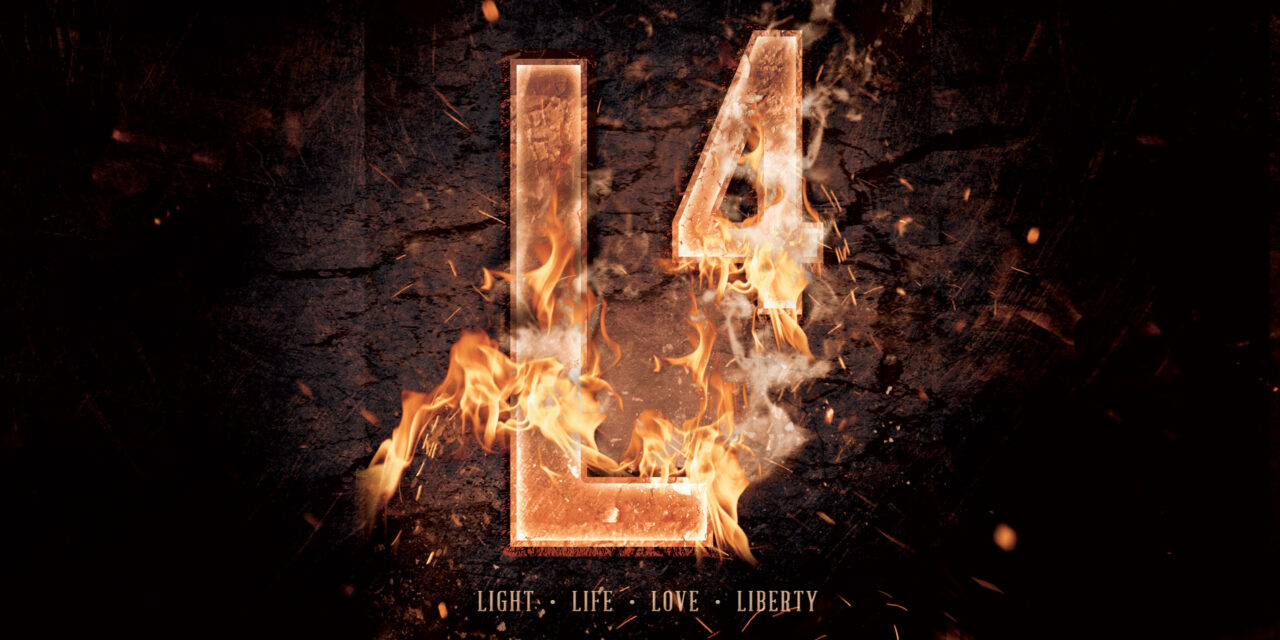
What is that formula Crowley thought so simple? I would not pretend to guess at his specific intentions, but it is not hard to see he was aiming at a pragmatic reading of Do what thou wilt. It is, after all, the whole of the Law. And while I agree with our first Prophet that our Law amounts to a truism, he gave us more than the truism. One of my favorite passages: “Know first, that from the Law spring four Rays or Emanations: so that if the Law be the centre of your own being, they must needs fill you with their secret goodness. And these four are Light, Life, Love, and Liberty.”6Crowley, Aleister, “De Lege Libellum,” in The Equinox: The Review of Scientific Illuminism: The Official Organ of the O.T.O.: The Equinox, no 3 vol. 10., ed. Hymenaeus Beta (Weiser Books, 1990), 63 (emphasis mine).
Light, Life, Love, Liberty—the four rays of the Law. It is as good a formula as any I know. We toss these words around in ritual and liturgy until they wear smooth, and they wear smooth because nothing is ever done with them, inside our communities or beyond them. Light, Life, Love, Liberty. Cliché enough to vanish in the conversation. I think it holds the keys to progress and to promulgation anyway.
So here is my proposal: that we use the Law to shine Light on knowledge, to enhance Life all around us, to increase Love between all things great and small, and to promote Liberty in the world by every measure. That is the core of our mission here today—to manifest Light, Life, Love, and Liberty through the pragmatic application of the Law. We do it by exposing needs in a greater community, expanding awareness in individuals and groups, and empowering solutions at the local level. Three verbs, and I want them said plainly: exposing needs, expanding awareness, empowering solutions.
In 2003 I came to understand that Thelema would never reconstruct the world Crowley wanted reconstructed until it could first identify that world. We are of the world. We have not found our way into it. We live there anyway—we work, we raise children, we sit in traffic, we bury our parents—and then we come back to our temples and our rites and our initiations and close the door behind us. The four emanations are interior, yes. The Law fills us once we have assimilated it. But out there is where anyone else is going to see it.
Crowley warned us about this, directly, in another letter to Jones.
It is necessary to broaden the scope of presentation of the Law of Thelema so that people of all types may be able to appreciate that particular part which they can understand. In this manner the thought processes of the majority will be so directed that all those who can Understand the Law will be given the opportunity to do so while at the same time providing a guide for those whose Understanding is incomplete.7Crowley to Jones, August 1945.
That is the rub, right there. “To broaden the scope,” he wrote. Fair enough. And he is right.
Allow me to do that here. Seven tributaries feed the current of society, and in some form they make up the core structures of every society I know of: Art and Entertainment, Business, Education, Family and Community, Government, Religion, Science and Technology.8You will also notice that these seven areas of human endeavor also match up to the six categories of Mere Thelema. Between them they cover the whole of human social endeavor. It is by carrying the Law of Thelema into each of these spheres that “people of all types may be able to appreciate that particular part which they can understand.”
The head of the United States Grand Lodge [O.T.O.], Frater Sabazius, has suggested, “While we have no duty to ‘convert,’ we do have a duty to disseminate the Law as widely as possible throughout human society, not just within specific sub-cultures, classes, and social groups.”9Sabazius X°, “From the Grand Master,” Agapé 10, no. 4 (February 2009), 3. He is correct, of course, though we had better keep our footing on the difference between promulgation and proselytization, whatever approach we take. He is speaking most specifically about membership in O.T.O., but he has hold of something fundamental: promulgation requires diversity.
Crowley again: “The open preaching of this Law … will arouse discussion and animosity, and thus place thee upon a rostrum whence thou mayst speak unto the people.”10Crowley, “Khabs am Pekht,” in The Equinox, 1990, 54–55.. We are gathered here to arouse discussion. We are here to talk about the Law, proudly, passionately, and pragmatically. Should we arouse animosity, so be it; but, in all things, we spread a message of Light, Life, Love, and Liberty.
“We would do well to view ourselves as infiltrators of all aspects of society, bringing Light wherever we go,” Frater Sabazius observed. “As such,” he continued, “we need members who belong to all professions, political parties, and social institutions; who can travel freely among all social strata; and who represent all cultural and ethnic groups. It does not serve our cause to associate only with people who look like us, talk like us, and share our personal tastes, interests, and opinions.”11Sabazius, “From the Grand Master,” 3.
And he’s right. But he missed the rest of it: that we are also to bring Life, Love, and Liberty to “all aspects of society.” We would do well to view ourselves, then, not as missionaries in the vulgar sense, and not as salesmen of a spiritual product, but as agents of a Law that has already begun its work in us and now demands expression through us.
Outreach is the word I would use, though the word has been ruined by people with clipboards. It is not standing on a corner shouting Do what thou wilt shall be the whole of the Law at strangers who wanted coffee and a quiet walk to the car. It looks like less than that and it costs a great deal more. It looks like the Thelemite who has served eleven years on a school board that meets on Tuesdays in a room with bad chairs. It looks like the one who drives a neighbor to the methadone clinic in a county with no bus line. This approach to Thelema is not less serious because it is not loud. It is not less magical because it is practical.
If anything, it may be more magical because it refuses the easy theatrics of self-importance.
The question before us is not whether Thelema has beautiful doctrines. It does. The question is not whether Thelema has profound mysteries. It does. The question is not whether our rituals, initiations, symbols, and texts possess depth enough to occupy a lifetime. They do, and many of us have already given our lives to them in one way or another. The question is whether any of it becomes visible, as Light and Life and Love and Liberty, in the life of a person who is not initiated, not convinced, and not standing around waiting to hear the Tree of Life explained by a man who has mistaken complexity for wisdom.
Light, if it is truly Light, illuminates. It does not merely decorate the altar. It shines upon ignorance, confusion, superstition, and fear. It asks us to teach, to clarify, to translate, to put knowledge back within reach of people from whom it has been hoarded or hidden behind the vanity of those who would rather be impressive online than useful within walking distance of their own front door. In Education, that means backing the kind of learning that leaves a fifteen-year-old harder to lie to, rather than the kind that trains obedience and calls the result a diploma. In Science and Technology, it means welcoming discovery without surrendering the human being to the instrument that is measuring him, or to the priesthood that owns the instrument. In Religion, it means speaking honestly about spiritual life and refusing to let it curdle into dogma, sentiment, or escape.
Life, if it is truly Life, strengthens. It does not merely survive in the locked chamber of the magician’s private attainment. It touches bodies, families, neighborhoods, economies, and institutions. It asks us to look without flinching at hunger, despair, loneliness, addiction, exploitation, and the many quiet wounds that polite society has learned to call normal. In Family and Community, Life asks us to build the sort of belonging a person can grow inside without being eaten by it. In Business, it asks us to stop pretending that work and wealth and exchange sit somewhere beneath the Law. A man working fifty hours a week who still cannot make rent is not free to discover anything, least of all his Will. He has no hours left in which to even wonder what that Will might look like.
Love, if it is truly Love, unites by distinction, and the distinction is not a technicality. Every Star is not to be made the same Star, the same color, the same orbit around the same exhausted sun. Two stars pulled close enough will tear each other apart; set far enough apart, they are nothing to one another at all. The distance between them is the relation. That is what love without possession means, and it is harder arithmetic than either the possessive or the indifferent would like to admit. In Art and Entertainment, it asks for work a person cannot put down and cannot quite settle after—very nearly the opposite of what the market is built to sell. In public life, it asks us to give up the pleasure of hatred, which is cheap, which is always available, and which arrives now pre-wrapped in a flag or a hashtag.
And Liberty, if it is truly Liberty, demands courage, which is why we hear about it more than we practice it. Not the adolescent courage of saying whatever comes into one’s head and calling the wreckage freedom. Not the courage of the partisan, which costs nothing and consists mostly of repeating the resentments of one’s own camp back to it. Liberty under the Law is a discipline. It asks a person to know himself well enough to be responsible, and then to stand there while somebody else discovers a Will that does not flatter him in the least. In Government, Liberty asks us to defend the conditions under which real human beings may pursue their lives without being crushed by tyranny, bureaucracy, poverty, or mob opinion. It asks us to oppose every system that makes slaves, whether the chains are legal, economic, religious, technological, or psychological.
This is why articulating these social vectors of engagement and influence matters. They are not a gimmick. They are not another diagram to hang upon the wall beside all the other diagrams we admire and ignore. They are a map of contact. They remind us that society is not an abstraction. Society is the artist trying to say something true. The teacher trying to reach the student. The parent trying not to pass down the wound they inherited. The worker trying to survive with dignity. The scientist trying to understand. The citizen trying to act without being swallowed by the machine. The seeker trying to pray without lying to themselves.
If Thelema has nothing to say about human endeavors, about “the whole nature of Man,”12Crowley, Aleister, Mary Desti, and Leila Waddell. 1997. Magick: Liber ABA. Edited by Hymenaeus Beta. Weiser Books, 429. then Thelema has very little to say at all.
I believe it has something to say. I believe it has something to do, which is a different claim and a costlier one, and it can only do that through our expression of the Law of Light, Life, Love, and Liberty in the world.
We should therefore stop imagining promulgation as the distribution of books, links, slogans, and clever (mis)quotations. Those have their place. They are not the work. The work is to create points of encounter where the Law becomes intelligible because it has become useful. This does not require diluting Thelema. It requires embodying it more completely. We need to speak plainly where plain speech is needed, poetically where poetry opens the heart, intellectually where rigor is demanded, and practically where people are simply trying to live.
This is our purpose with Mere Thelema.
Crowley said we must talk in a language everybody can understand. That does not mean we abandon our mysteries. It means we stop using mystery as an excuse for failure. It means we learn to speak to the mother, the machinist, the student, the public servant, the wounded believer, the honest skeptic—and to the exhausted soul who has no name for the thing he is after but knows, somehow, that his life is meant to be more than obedience and consumption.
In Liber Cordis Cincti Serpente it is written, “And the Lord Adonai delighteth in me, and I bear the Cup of His gladness unto the weary ones of the old grey land” [Cor 5:61].
That is a beautiful image, and perhaps it is enough to hold before us as we begin. We do not bear the Cup only to those who already know the ceremony. We bear it to the weary ones of the old grey land. We bear it to a world tired of dead language, dead institutions, and—most certainly—dead hope. We bear it not as conquerors in the crude sense, but as people who have tasted something of gladness and cannot in good conscience keep it sealed away.
So let this be our charge.
Let us expose needs where comfort has hidden them. Let us expand awareness where fear has narrowed the field of vision. Let us empower solutions where helplessness has become the common religion of the age.
Let us move through Art and Entertainment, Business, Education, Family and Community, Government, Religion, and Science and Technology as bearers of Light, Life, Love, and Liberty.
Not as custodians of a museum. Not as children playing dress-up in the ruins of someone else’s revelation.
As Thelemites. As Stars. As men and women willing to take the Law seriously enough to let it pass through our hands and into the world.
Love is the law, love under will
Johnathon Victor Reese
Editor-in-Chief
Mere Thelema
- Aleister Crowley to C. S. Jones, February 1916 (emphasis mine). ↩
- Crowley to Jones, February 1916 (emphasis mine) ↩
- Crowley to Jones, August 28, 1936. ↩
- cf. Strange Angel, created by Mark Heyman, aired 2018–2019 on CBS All Access. ↩
- Read up on The Heritage Foundation and Project 2025, if you haven’t already. ↩
- Crowley, Aleister, “De Lege Libellum,” in The Equinox: The Review of Scientific Illuminism: The Official Organ of the O.T.O.: The Equinox, no 3 vol. 10., ed. Hymenaeus Beta (Weiser Books, 1990), 63 (emphasis mine). ↩
- Crowley to Jones, August 1945. ↩
- You will also notice that these seven areas of human endeavor also match up to the six categories of Mere Thelema. ↩
- Sabazius X°, “From the Grand Master,” Agapé 10, no. 4 (February 2009), 3. ↩
- Crowley, “Khabs am Pekht,” in The Equinox, 1990, 54–55. ↩
- Sabazius, “From the Grand Master,” 3. ↩
- Crowley, Aleister, Mary Desti, and Leila Waddell. 1997. Magick: Liber ABA. Edited by Hymenaeus Beta. Weiser Books, 429. ↩