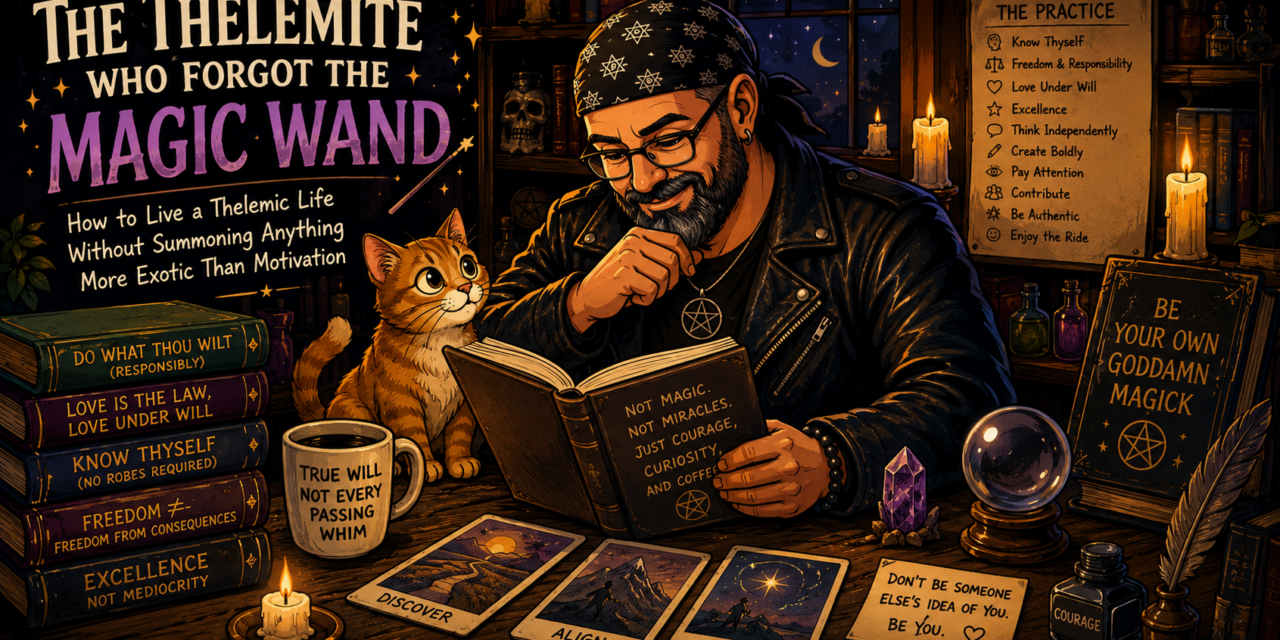
Mention Thelema in polite company, and someone will almost certainly picture flickering candles, mysterious robes, strange symbols, and enough ancient books to make a university librarian nervous. If the image includes an ominous skull, a crystal ball, and someone chanting in Latin, all the better.
That reputation is understandable. Aleister Crowley did not exactly market Thelema as a simple guide to living your best life. He certainly did not help matters by being the sort of person who could turn a quiet walk into a scandal. He surrounded it with ceremonial magic, elaborate rituals, and enough occult symbolism to keep scholars busy for generations. It is no surprise that many people assume the philosophy cannot exist without the magical trappings.
The amusing part is that the magic is not really the point.
At its heart, Thelema is about discovering who you truly are and then having the courage to live as that person. That sounds wonderfully simple until you actually attempt it. Most of us spend years becoming versions of ourselves that satisfy parents, teachers, employers, spouses, religions, or society in general. We become reliable, responsible, successful, agreeable, or respectable because those qualities earn approval. Eventually those borrowed identities become so familiar that it is difficult to remember which parts belong to us and which parts arrived as somebody else’s expectations.
The central challenge of Thelema is not learning to invoke angels or memorize complicated rituals. It is learning to stop living somebody else’s life. Ceremonial magic is one way that some people pursue that goal, but it is far from the only one. Others discover themselves through art, psychology, meditation, travel, business, relationships, or simply making enough mistakes to begin recognizing the patterns.
Life, it turns out, is a remarkably effective initiatory system all by itself.
True Will: The Thing Nobody Can Hand You
The most famous idea in Thelema is also the one most people misunderstand. When newcomers hear the phrase, “Do what thou wilt shall be the whole of the Law,” they often assume it is a philosophical permission slip to do whatever feels good in the moment. If that were true, True Will would involve sleeping until noon, eating dessert before dinner, and buying books faster than anyone could possibly read them.
Thelema means something much deeper. True Will is not every passing desire that wanders through your mind. It is the deeper current beneath those desires, the direction your life naturally wants to move once fear, guilt, insecurity, and social expectations stop grabbing the steering wheel. Discovering it is less like granting yourself permission to indulge every whim and more like uncovering something that has quietly been waiting for your attention all along.
The difficulty is that nobody can tell you what your True Will is. Human beings adore instructions. We love personality tests, online quizzes, inspirational seminars, and experts who promise to reveal our purpose in seven convenient steps. Unfortunately, True Will refuses to cooperate with that business model. It asks uncomfortable questions instead. What kind of work makes time disappear? What interests have stayed with you for years? What would you pursue if applause, money, and approval suddenly disappeared? What work feels meaningful even when it is difficult?
What would you pursue if nobody was watching?
Most people do not discover those answers in a single dramatic revelation. More often they stumble toward them through failed careers, abandoned dreams, unexpected opportunities, and the occasional realization that they have been climbing the wrong ladder for twenty years. That is not failure. It is simply the process of removing everything that was never really yours in the first place.
Know Thyself: The Most Important and Least Glamorous Adventure
Self-discovery has excellent public relations. It is usually advertised as an inspiring journey filled with profound insights and dramatic moments of enlightenment. Reality tends to be considerably less glamorous. More often it involves sitting quietly with a journal, talking to a therapist, taking long walks, reading difficult books, or staring into the refrigerator while wondering why life suddenly feels out of alignment. It looks like having an uncomfortable conversation with yourself after realizing you have been making the same mistake for ten years.
Thelema insists that self-knowledge is not optional because authentic action is impossible without it. If you do not understand your fears, motivations, habits, strengths, and blind spots, someone else will eventually define them for you. That is one reason so many people wake up in middle age wondering how they ended up living a life they never consciously chose. They simply followed a script that seemed reasonable until it no longer did, forgetting to ask whether it was even their script.
Fortunately, magical rituals are not the only path toward self-knowledge. Psychology, meditation, education, creative work, honest friendships, and simple reflection can accomplish much of the same work. The important thing is developing the willingness to look at yourself honestly, even when the truth is inconvenient. There is very little glamour in admitting that your biggest obstacle has been your own fear, but there is enormous freedom in finally recognizing it.
Freedom Is Wonderful Until It Comes With Responsibility
Everybody likes the idea of freedom. The difficult part is accepting everything that arrives with it. Most people secretly hope for freedom without consequences, independence without uncertainty, and unlimited choice without the possibility of making spectacular mistakes. Life has never offered that particular package.
One of the strengths of Thelema is that it places responsibility squarely back where it belongs. If you are free to pursue your own path, then you are also responsible for the direction your life takes. That can feel intimidating because it removes many of our favorite excuses. Blaming parents, employers, politicians, bad luck, Mercury retrograde, or mysterious cosmic forces eventually loses its appeal when the same question keeps returning: “What are you going to do now?”
That question is not meant to inspire guilt. It is meant to inspire action. Circumstances certainly matter, and some people face obstacles that others never encounter. Thelema does not deny that reality. What it refuses to accept is the idea that circumstances should become permanent permission to surrender your agency.
Oddly enough, accepting responsibility often feels lighter than avoiding it. Once you stop waiting for perfect conditions or somebody else’s approval, you begin noticing how much influence you already have. It may not be unlimited, but it is usually enough to begin moving in the right direction. Not unlimited power. Just enough. Which is usually more than we think.
Love Under Will: Freedom Without Becoming Insufferable
One misconception about Thelema is that it celebrates selfishness. People hear discussions about individual Will and immediately imagine a philosophy that encourages everyone to ignore the needs of others while pursuing personal happiness with reckless enthusiasm.
The second major principle of Thelema quietly corrects that misunderstanding: “Love is the law, love under will.” It reminds us that genuine freedom and genuine connection are not enemies. In fact, they depend upon each other. Every person is attempting to solve the same basic puzzle of existence, even if their methods occasionally resemble assembling furniture with missing instructions.
Recognizing that simple fact changes the way we treat people. The impatient driver in traffic, the difficult coworker, and the relative who insists on explaining cryptocurrency during holiday dinners are all trying to navigate life as best they can. Some are doing better than others, but everyone carries invisible burdens.
Living according to your own Will therefore includes respecting the right of others to discover theirs. Freedom that belongs only to you is not really freedom at all. It is merely ego wearing philosophical clothing.
Excellence: The Alternative to Sleepwalking
Almost everyone knows what it feels like to drift through life for a while. Weeks quietly become months, months become years, and before long routines begin making decisions on our behalf. Responsibilities multiply, habits harden, and one morning it becomes difficult to remember when life stopped feeling intentional and started feeling automatic.
Thelema pushes back against that drift by encouraging people to take their own potential seriously. Notice that it says nothing about becoming famous, wealthy, or influential. Those things may happen, but they are side effects rather than goals. The real objective is excellence, and excellence is very different from perfection.
Perfection is usually driven by fear. Excellence is driven by care. Perfection worries endlessly about appearances, while excellence asks only whether you are becoming better than you were yesterday. One mindset creates anxiety. The other creates growth.
Whether your passion is writing, teaching, engineering, woodworking, gardening, or raising children, the principle remains the same. Meaningful work becomes an expression of who you are. There is something deeply satisfying about becoming genuinely skilled at something you truly care about. It feels less like chasing success and more like finally fitting into your own life.
The Sacred Art of Ignoring Bad Advice
If advice were a renewable energy source, humanity would never experience another power shortage. Friends offer it freely. Family members offer it enthusiastically. Complete strangers on the internet distribute it with astonishing confidence despite having no idea who you are.
Some advice deserves careful consideration. Some deserves immediate recycling. Some of it sounds as though it was generated during a head injury.
Thelema encourages independent thought, which does not mean rejecting expertise or assuming that every opinion has equal value. It means accepting responsibility for your own judgment. Many of the beliefs people carry throughout adulthood were never consciously chosen. They inherited them from family, culture, religion, education, or social expectations and simply forgot to question them.
Learning to think for yourself is an ongoing discipline rather than a single dramatic event. It requires curiosity, humility, and the occasional willingness to admit that an idea you defended passionately for years was simply wrong. Nobody enjoys that experience, but growth seems unusually fond of arranging it.
Creativity: A Most Respectable Form of Chaos
Human beings have a curious need to create. We write stories, start businesses, compose music, build furniture, paint pictures, plant gardens, and occasionally attempt home improvement projects that should have remained theoretical. Creating something satisfies a part of us that endless consumption never quite reaches.
Thelema recognizes creativity as one of the clearest expressions of individual Will. When people create something meaningful, they almost always discover something about themselves in the process. A novel reveals hidden interests. A painting uncovers forgotten emotions. A business exposes unexpected strengths. Even a vegetable garden has a remarkable way of teaching patience, humility, and the occasional lesson about squirrels.
Creating anything worthwhile requires resilience because very little emerges perfectly on the first attempt. Every artist, entrepreneur, musician, and craftsperson accumulates embarrassing early efforts. Fortunately, masterpieces rarely announce themselves at the beginning. They tend to emerge after many failed experiments and an unreasonable amount of persistence.
That process may not qualify as magic, but it certainly feels mysterious enough to keep people coming back.
Paying Attention in a Distracted World
Modern life has transformed attention into one of our most valuable resources. Every notification competes for it, every advertisement wants to capture it, and every social media platform is convinced that another five minutes of your life would be a perfectly reasonable donation.
Thelema quietly suggests that awareness may be one of the most important skills a person can develop. When you learn to pay attention, you begin noticing habits before they become prisons, emotions before they become decisions, and opportunities before they quietly disappear. That kind of awareness can be cultivated through meditation, journaling, thoughtful reading, long conversations, or simply learning to spend time without constant distraction.
Many people spend enormous amounts of energy regretting the past or worrying about the future. Meanwhile, the present moment quietly waits for somebody to notice it. Since every meaningful choice can only be made in the present, learning to remain there may be one of the most practical spiritual disciplines ever invented.
Community and the Myth of the Lone Rebel
Popular culture loves the image of the lone rebel standing courageously against the world. It is a compelling story, but it leaves out an important detail. Most meaningful lives are built in relationship with other people.
Friends shape us. Families influence us. Communities challenge us. The question is not whether we should withdraw from society but whether we can remain authentic while participating in it. Too many people spend years performing roles they never consciously chose because the performance feels safer than honesty.
Thelema offers a healthier alternative. It encourages people to contribute to the world without surrendering their individuality. Healthy communities are not built by people who all think alike. They are built by people who know themselves well enough to contribute something genuine.
There is remarkable freedom in realizing that belonging does not require pretending. Quite the opposite. The more honestly you become yourself, the more valuable your contribution often becomes.
The Most Magical Thing Might Be Becoming Yourself
After all the discussion about philosophy, Will, freedom, and purpose, the greatest irony of Thelema remains wonderfully simple. Its deepest challenge has almost nothing to do with ceremonial magic.
The real work is becoming yourself.
That journey rarely unfolds through dramatic revelations. It happens through thousands of ordinary decisions: choosing honesty over comfort, curiosity over certainty, responsibility over excuses, and growth over familiarity. It happens when you begin letting go of the life you think you are supposed to live and start building the one that genuinely belongs to you.
Whether someone discovers that path through ritual, psychology, art, meditation, meaningful work, or years of trial and error matters far less than many people imagine. The destination is the same. The goal has always been to live deliberately, authentically, and courageously.
In a world that constantly encourages imitation, distraction, and conformity, becoming yourself may be the most radical thing you will ever do. The best part is that no wand, robe, secret handshake, or ancient incantation is required. All it takes is the willingness to keep asking one simple question throughout your life:
“Is this really my path?”
If you can answer that question honestly, you are already much farther along the Thelemic path than you may have realized.
No wand required.