There is an old saying that “words have power.” It is not just something embroidered on a throw pillow at a yoga retreat. It is an actual neurological fact. The words we use shape how we see ourselves, how our brains fire, and how other people treat us. So when someone stands up and says, “Hi, I’m an addict,” the word lover in me dies a little.
Now, before anyone reaches for the pitchforks or the coffee mug that says One Day at a Time, let me make something perfectly clear. Recovery is beautiful, courageous, and often hilarious in its own tragic way. But the label addict is like using the word plague victim to describe someone who once had a bad cold. It is technically true, but a little dramatic, and you deserve better branding.
Words Are Spells
We just cast the wrong ones far too often.
The Four Agreements, by Don Miguel Ruiz, has a rule for exactly this: be impeccable with your word. Speak with integrity, skip the self-judgment, and aim your words at truth and love—other people’s and your own. Words build or they wreck.
If you have ever shouted at your phone for autocorrecting ducking wrong, you already understand that words carry emotional voltage. Neuroscientists have shown that repeating a self-description literally rewires your brain. When you keep saying “I’m an addict,” you are reinforcing the neural pattern that says, “This is what I am.”
That is a powerful spell to cast against yourself before you have even had your morning coffee.
Imagine if every morning you introduced yourself with your least flattering trait. “Hi, I’m Steve, and I’m chronically late.” “Hi, I’m Marsha, and I’m emotionally unavailable before noon.” We would all be spending a lot more time job hunting.
But we do not do that, because deep down we know those labels limit us. Yet we make an exception for addiction. Why? Because someone in 1930 decided it was therapeutic. This is the linguistic equivalent of using a rotary phone in the age of Wi-Fi.
You Are Not Your Brain Chemistry
When you say, “I’m an addict,” you are collapsing an incredibly complex human being—one who loves cats, overcooks pasta, and cries during Pixar movies—into a single, unflattering noun. Technically true, but wildly and dangerously insufficient.
Addiction is a behavioral pattern, not a personality. It is something your brain did, not something your soul is. You would not call yourself a broken leg after falling off a skateboard, right? You would likely say, “I broke my leg,” which implies it can heal.
But “I’m an addict”? That’s linguistic superglue. It sticks to your identity and refuses to come off, even when you have changed.
The Universe Is Listening (and It’s Kind of Literal)
Your words shape your reality. Whether you believe in quantum manifestation or just the placebo effect, saying “I amsomething” tends to make it true.
If you walk around saying, “I’m tired,” your body listens. Say it often enough, and you will need a nap before lunch. So what happens when you repeatedly declare, “I’m an addict”? You have built an altar to that identity, and you keep lighting candles on it.
Try saying, “I’m a person in recovery,” or even, “I used to have an addictive relationship with [insert substance/behavior/Netflix show].” Suddenly you are not stuck. You are in motion. You are someone evolving, not someone doomed. The difference is subtle but seismic.
Identity Inflation Is Real
Our culture has an identity problem. Everyone wants a label. Introvert, empath, ADHD-coded forest sprite, and stranger ones still. We are so busy naming ourselves that we forget to be ourselves.
The addict label can become a social currency in certain circles. It is shorthand for authenticity, suffering, or hard-won wisdom. But it also traps you in a narrative you might have outgrown.
Think about it. Would you continue to call yourself a teenager because you once owned a skateboard and made questionable decisions? Probably not. So why cling to a label that describes an earlier, less evolved version of yourself?
You are not betraying your recovery by dropping the word “addict.” You are upgrading your operating system. Read that again. I’ll wait.
Humor Is the Ultimate Detox
We get so serious about recovery that we forget laughter is medicine too. Perhaps the best medicine. The moment you can joke about your past without minimizing it, you have loosened its grip.
Instead of saying, “I’m an addict,” try something more honest and fun, like:
- “I’m someone who used to think tequila was a vitamin.”
- “I’m a retired chaos enthusiast.”
- “I’m in a committed relationship with hydration and good decisions.”
These are still self-aware, but they leave space for joy. They acknowledge growth instead of glorifying the wound.
Liberation Through Language
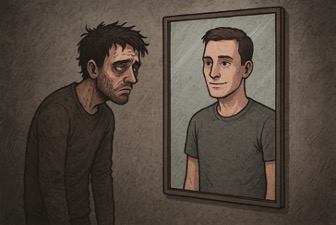
When you stop identifying as an addict, you are not denying your past, you are reclaiming your narrative. You are saying, “That happened to me, but it’s not the headline of my life.”
Language is like clothing: you can wear whatever fits. But if you keep walking around in an identity that is three sizes too small, you will never breathe comfortably.
Try on new words: survivor, seeker, learner, phoenix, person-who-has-seen-some-stuff-and-now-prefers-tea. Whatever fits your vibe. The important part is that you choose the words, not the other way around.
Please do not mistake all of this for the “Good Vibes Only” thing. That is bullshit. Denying that darkness exists at all is just as ridiculous as believing only darkness exists. And NEVER say such a thing to anyone. Doing so is the same as saying “My comfort is more important than your reality.” No need to be an asshole.
Words are magic. Every time you say “I am,” you are writing a tiny spell that defines who you are. “I’m an addict” is a spell that keeps the old ghost alive. But “I’m free,” “I’m healing,” or even “I’m figuring it out one awkward day at a time”? Those are spells that open doors.
So next time someone at a meeting, a dinner party, or a date asks who you are, take a deep breath and say something wild, true, and alive.
You are not an addict. You are a human being with a past, a mind, a pulse, and an occasionally terrible sense of humor. Just like the rest of us.
And honestly? That is far more interesting.