In this essay I hope to show that you don’t need to be rich to build a sanctuary, you don’t need to be influential, or powerful, and you don’t need to put in a lot of work, provided that you work intelligently, within the means of your own energy, and the ecosystem of your own life, to follow your vision carefully to its creative end. A low effort, zero budget sanctuary is not at all impossible. In fact, if you happen to be free this afternoon, it can probably be done today.
Choose ye an island! Fortify it! Dung it about with enginery of war! I will give you a war-engine! (AL 3:4–7)
“By certain Meditations this may be understood and established; and this ought to be done so thoroughly that we become unconscious of our Sanctification, for only then is Innocence made perfect. This state is, in fact, a necessary condition of any proper contemplation of what we are accustomed to consider the first task of the Aspirant, the solution of the question. “What is my True Will?” For until we become innocent, we are certain to try to judge our Will from the outside, whereas True Will should spring, a fountain of Light, from within, and flow unchecked, seething with Love, into the Ocean of Life.
“To regain Innocence is to regain Eden.”
—Aleister Crowley, The Book of Thoth.1
“Establishment of the Law of Thelema is not meant in the sense of establishing a political kingdom of Ra-Hoor-Khuit, or launching a coup d’état against the present centres of power in society. Rather, it is a case of bringing the Law of Thelema to more general awareness; and this is best served by applying it to ourselves, by discovering our True Will and fulfilling it. There is an analogy with the Law of Gravity, where ‘establishment’ is in the sense of acknowledgement, of its acceptance and use as a universal principle.
“In a sense this is anarchy – the anarchy of the oak, which flowers in its season in accord with its natural rhythm.”
—Michael Staley, The Heart of Thelema.2
Thriving Sanctuaries
Once upon a time, in a small village, there lived a mailman. One day on his route, delivering the mail, he stumbled on a rock. He looked at it, thought it was beautiful, and put it in his pocket. The next day he found more rocks. After a while he began to carry a basket, and after another while he decided that a wheelbarrow was necessary. He was building a palace from his imagination, inspired by postcards, and magazines, but most of all inspired by his dreams. It took him 33 years to finish his work. He was often ridiculed by the village people, but in the last years of his life he was recognized for his art by luminaries such as Pablo Picasso, and André Breton. After his death, Anaïs Nin even wrote about him in her diaries. Today his palace has been declared a cultural landmark, and in 1986, the face of Ferdinand Cheval, 1836–1924, was featured on the official postal stamps of his home country, France. The face of the mailman, in the end, appeared on the mail, more than sixty years after he was put to rest in a mausoleum he had built for himself from the rocks he had found so beautiful to begin with. This is the story of a high-effort sanctuary, but it’s also a story of humble efforts, and the audacity to simply pick up your dreams where you find them, and to keep going, for no other reason than to follow your dreams. Le Palais Idéal is not a palace you can live in, but perhaps it is a palace you can live by. At least it’s a good example of what I mean by building a sanctuary, and perhaps it’s even a good example of True Will. At least as far as we can observe such an elusive thing in one another, at all.
Another person who picked up her dreams where she found them, is a woman who was born by the name Megan Ruth-Trump, in Bristol, England. She became Mrs. Meg Avon, as she married her local river, the River Avon, only three years ago, in 2023.
At the time she told the media that what started as a joke quickly turned into something bigger. And what began as a concern for water pollution, and an interest in wild swimming, seems to have turned into a whole new way of life. Today she is a full-time campaigner, and researcher, and her life is devoted to the river. Being a river wife, she works for the river’s well-being, and protection. Besides research, and activism, this also includes swimming, ceremonial activities, community activities, and writing poetry about the river, whom she calls her darling. I think of her work, her art, and her initiative, because without much ado, she showed the world what is sacred to her. It revealed itself in a joke, and she bravely kept her promise. Her work unfolds in our own time, and where the river might take its bride, nobody knows.
But a sanctuary need not be tied to a place. A sanctuary can also be tied to an object, and a practice, stretching across time and place, connecting strangers that might never meet each other, allowing them to find a spiritual shelter, anywhere, and anytime.
Tarot cards are like that. A pocket-size sanctuary that folds neatly to fit your hand. A Tarot deck is an object, with the material history of an object. It is a popular object, used by many. The sheer number of existing Tarot decks is staggering. The most popular deck is the Rider-Waite-Smith deck, and it is estimated that it has been printed a hundred million times. But there are thousands of distinct Tarot decks. Tarot cards are therefore widely accessible. They can be found almost anywhere, and if you look, you are likely to find one. But the practices are even bigger than the object. Although this particular object in itself has a dendritic nature, what keeps it alive, and what keeps it from turning into nothing more than scattered leaves, is the use of it. The use is the roots, and branches of the Tarot. The use is what keeps it alive, and what keeps it growing, and moving. The use is also what qualifies it as a sanctuary. The object itself is little more than a set of playing cards. Unless the cards are assembled, arranged, and understood, the sanctuary is simply not there. The stones were beautiful before Ferdinand Cheval found them beautiful, the river was beautiful before Mrs. Avon married it, but only when they became part of the process of turning dreams into reality did they become the stuff of dreams. Something of the human spirit was revealed, and communicated back to humanity. That is what a sanctuary does. It lets you enter the dream world through your senses. It connects the pathways of communal dreaming. It allows what is not yet real, or not yet known, to arrive where we are, and enter into real, and known, relationships.
Tarot cards are not ancient, they are approximately 600 years old. They do not have a mysterious origin. They were born from playing cards, and just like books, they were born from the printing press, and the art of papermaking. Books are another large-scale sanctuary. We take books for granted, but books have not always existed, and books depend on our practices too. The fact that we read them, share them, and keep them safe, keeps them alive. Digital text can be rewritten at any moment—changed, manipulated, or deleted. A book is what it is. Books are not only filled with knowledge, they are also filled with the stuff of dreams. They come from dreams, and to dreams they return. The same is true for a card reading, whether you use a single card for contemplation, or gather to tell stories with your friends. The dreams that occur take on a life of their own, and the dreaming goes on.
It is told that arriving in France in the 1950s, Alejandro Jodorowsky wanted to give a Rider-Waite-Smith deck to André Breton. But Breton declined the gift, and told Jodorowsky that the symbols in it were too obvious. He preferred the Marseille decks. This sent Jodorowsky on an adventure that the world would soon hear about. But what really interests me is not his movies, or books, but the practice itself. For decades Jodorowsky captivated the general public with informal Tarot classes, open to anyone, and card readings offered to strangers over a cup of coffee, in small cafés, in Paris. There was no advertisement, and no fee. In an interview Jodorowsky mentions it himself: “I never advertised it, since I started, and it’s free. At the end people make a collection to pay for the space, like in a church. But it’s by word of mouth, there’s never been any publicity in fifteen years. Because I decided precisely to show that what people think is necessary, is not.”3
On Sacred Ground
The island you choose to live on, protect, and cultivate is ultimately always deeper than the thing itself, even if you would be lucky enough to find yourself on an actual island. Underneath the object, we notice the practice, and underneath the practice, we notice the dream, and underneath the dream sits the dreamer, dreaming. Underneath the dreamer the true mysteries begin.
A sanctuary cannot be a deck of cards, (although it is filled with wonders), it cannot be a cathedral, (forgive me for saying so, but it needs to be said), it cannot be a theater, (if the theater is empty), it cannot be a quiet spot, deep inside an old-growth forest, (maybe for the birds, and the bees, but not automatically for you). A sanctuary cannot be the island itself—without you. With you, it need not be an island. It can be anything, or almost nothing at all.
This is what Ferdinand Cheval knew when he picked up the rock he stumbled over. This is what the early Tarot readers of Europe knew, when they picked up a deck that sat in the parlour, gathering dust. This is what the poets all knew, when they picked up a pen, and went ahead with their writing.
A rock is an island, a deck of cards is an island, a pen is an island—if you want it to be. It’s very much all up to you. A sanctuary is whatever you sanctify, but unless you worship idols, it’s never the thing itself. What is sanctified depends on what you hold sacred, and that depends on all sorts of things—who you are, what you believe, and where you believe the power to sanctify comes from, and to whom it belongs. I believe it belongs to you. Because if a mailman can sanctify a rock, I can sanctify a potato stew. This is not a dismissal of the sacred. To the contrary, it’s an embrace of the miracle of living a spiritual, and creative life, surrounded by all things holy.
Thelema speaks extensively about what is sacred, and what is not. There is no lack of poetry in a religion founded by a poet, and no lack of blasphemy for the blasphemer, either. One might debate endlessly about the details of the sacred in Thelema, its mysteries, and deeper meanings—but a few things are certainly sacred. Creativity is certainly sacred. The pursuit of True Will is certainly sacred. If you are in pursuit of True Will, the ground you’re standing on is already sacred, just by you standing on it, and what you’re trying to realize is probably already happening, but on a deeper level, beneath the dream, and beneath the dreamer. You might stop to think for a moment, and ask—now, what is that?
I’m not a master of any kind, so like most people, I have no idea what’s going on at that level of creativity, reality, and life. I’ve only noticed that it does, and calling it True Will works for me. The way I have come to call it holy is that I have seen what it does to people. To animals, plants, communities, and even cities. When you hold on to an island in life, and you care for it, protect it, and treat it as something sacred, it develops, reveals itself, perhaps even responds, in more, and more wholesome, and meaningful ways. Living things thrive when you allow them to come into their own nature. They become themselves, they expand inwardly, become spacious, generous, and often peaceful, or at least, at peace with what they are. They blossom, and give fruit. A bunker cannot do that, because a bunker is an artificial enclosure. A sanctuary, on the other hand, is a natural opening—into ever deeper realizations, and relationships.
Failing Wars
A bunker requires enormous material resources, and innumerable hours of organized, physical labour. Still, it’s an almost impossible project. And even if you manage to build yourself a bunker, you might still accidentally choke on your food, trip on your shoelaces, or suffer an unexpected stroke. Life in a bunker is almost as unpredictable as life without a bunker, which is the irony of the bunker dream. All the things that are hard to fit into a bunker, are relatively easy to fit into a normal life. Air, water, food, exercise, and the rest of it, are only luxuries if they are hard to come by, and they shouldn’t be, not for anyone.
It is generous to say that humanity invented the atom bomb, but let’s be generous, and share our burdens. The atom bomb was invented, and with it came the invention of private bunkers. As the Cold War played out, in the U.S.A., public bunkers were conceived of as something almost akin to Communism, and the art of dying became each man’s private burden instead. In Scandinavia we still have public bunkers, and we face our mortality collectively, not each man for himself. Regardless of these differences, shelter or die became the narrative of the Cold War. According to an old article from The Conversation, Langston Hughes reportedly commented on the era: “If the bomb does come, let’s all just die neighborly.”4 It echoes the comments of C.S. Lewis who settled himself on a similar answer:
It is perfectly ridiculous to go about whimpering and drawing long faces because the scientists have added one more chance of painful and premature death to a world which already bristled with such chances and in which death itself was not a chance at all, but a certainty. This is the first point to be made: and the first action to be taken is to pull ourselves together. If we are all going to be destroyed by an atomic bomb, let that bomb when it comes find us doing sensible and human things — …5
An honest Thelemite cannot talk about islands without talking about the machinery of war, or even about the mysterious war engine. One cannot cut one verse from the other, slice what is holy into bite-size pieces, and turn something awesome into something digestible, and polite—so I won’t.
If something is sacred, it deserves to be protected.
A child deserves to be protected from a predator. The ocean deserves to be protected from the fishing industry. A work of art deserves to be protected from an angry mob. This is all common sense. But one must still think carefully about these things, because they are serious.
Thelema speaks of war, and war is a difficult topic, but war is real. The world is at war every day. We don’t really have the privilege to ignore it, and even if we do, maybe we shouldn’t. Ignoring the difficult realities of life on Earth only favors the predator, the corrupt industry, and the angry mob.
War makes you feel small, very small. It makes you see how very little you can carry in a backpack, how very little you can actually endure, and how very little you can do about anything at all. It also forces you to realize that you must do all of it anyway. It leaves no room for despair, and no time for self-doubt. It doesn’t matter how little you can do, it must be done, and it must be done urgently.
At the level of the state, war must have a political end-goal in order to be successful. If you don’t know what you’re fighting for, war becomes pointless, disorganized, and self-defeating. If you don’t know what victory means, or even whether your latest attack was a success, or a failure, you won’t know when to stop. If you don’t know when to stop, war goes on indefinitely. Dialogue is impossible under such circumstances, so is efficiency, frugality, and ultimately, peace. Lately a few experts have commented that many of the wars going on in the world today suffer from this sort of confusion. War doesn’t work without a clear political end-goal, and in this regard war has stopped working. Killing people for no reason is pointless murder, not wartime politics. When politics is no longer about what the people want, deserve, or need, the end-goal is no longer about the people at all. Which means, it’s no longer about you, or me. A lot of it seems to be about corrupt leaders, their wealth, power, and personal safety. The end-goal is often obscured these days. The threat is not always that the enemy might burn your village to the ground. The threat is sometimes coming from the fact that your own leader might be facing jail time if the fighting stops. Very few of those who are in power benefit from protecting a village. Very few of them care about villages, or people. And at this point it is very difficult to determine what many of the wars are really about.
Meanwhile, the world is experiencing the highest number of armed conflicts since WW2, while experts warn that the rules of International Humanitarian Law are increasingly being ignored, and dehumanization is increasingly normalized.
In 2005, 50% of the world’s population lived in democracies. Today that same number is 26%. Only 7% are living in liberal democracies. The U.S.A. has lost its status as a liberal democracy for the first time in over 50 years.
This should cause us all to stop and think. If we are fighting for democracy, then why are we losing?
Beyond the battlefields, there is a different kind of war going on. It happens inside our own homes, or rather, inside our own phones. This is the war most of us participate in—the information war. The worldwide decline in democracy is not simply a result of armed conflict, and the outbreaks of armed conflict do not happen by accident. The erosion of democracy proceeds inch by inch, until suddenly one day, the landscape has changed completely. Of all the factors holding liberal democracy together, freedom of expression stands out because of its rapid global decline. Censorship of the media stands out as the preferred tool of autocratic leaders, seeking to dismantle democratic structures from within the state itself.
This is the world into which we build our sanctuaries. A world where freedom of expression has become a tool in the hands of autocracy. A world where we must take our freedom seriously, and use our self-expression wisely. A world of pointless wars, (unless you care deeply about protecting our leaders). A world where cognitive dissonance stirs at the back of every mind, begging us to fall in line with the propaganda. Tempting us to apathy, or rage, as if those are the only two options. Here, at last, a sanctuary provides us with a third option. We don’t need to fall in line. We can resolve cognitive dissonance through our spiritual, and somatic, practices. We can use active protection against propaganda, instead of retreating into numb defeat, or fearful isolation.
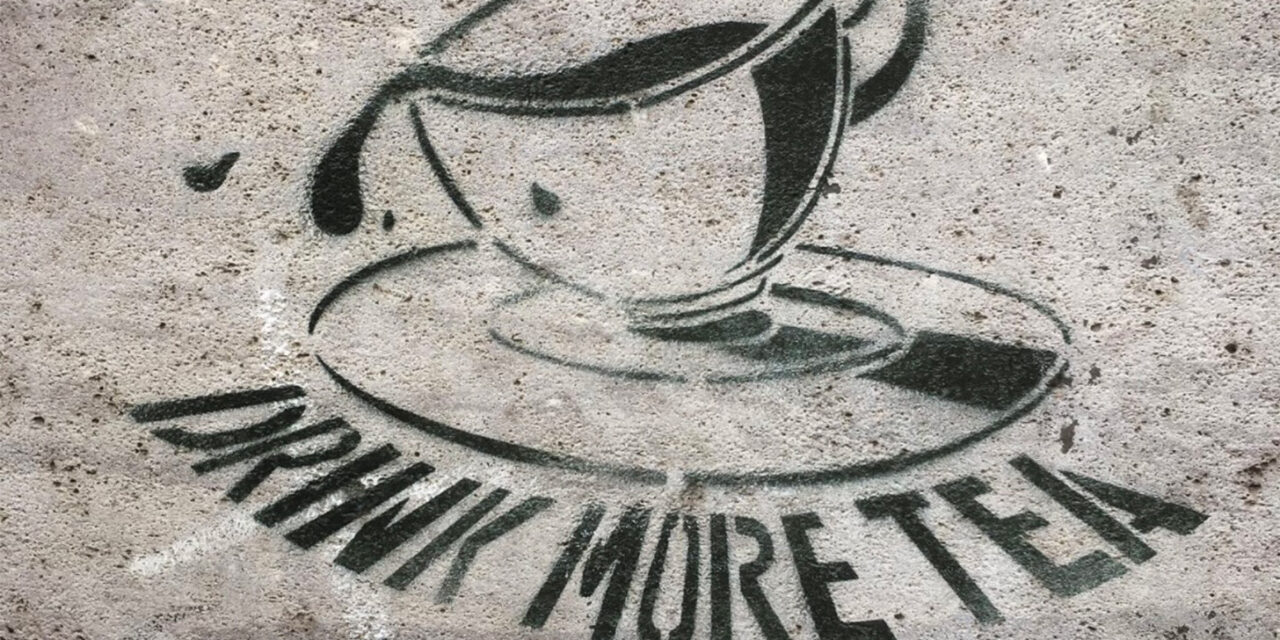
But this too begins with yourself. Before you can hold anything sacred, you must believe that it matters how you feel about the world, and you must believe that it matters what you do with that feeling. In the face of these enormous forces everything feels small, but a small sanctuary is a lot better than no sanctuary at all. If contemporary wartime politics are becoming more, and more pointless, then any sort of point you can make in the other direction—the direction of love, and meaning—is powerful, because it stands out in contrast to the pointlessness itself. Even a cup of tea can point in the right direction.
Albert Camus might have preferred a cup of coffee. André Breton unfortunately lost his sense of meaning, when faced with the absurdities of his own time, and perhaps, of his own mind. Camus wrote about Breton’s extreme surrealist standpoint, to conclude that in the end, it was nothing more than destructive nihilism. Breton had answered pointlessness with even more pointlessness when he wrote: “The simplest Surrealist act consists of dashing down into the street, pistol in hand, and firing blindly, as fast as you can pull the trigger, into the crowd.”6
It may be the saddest, (not to say worst), statement in the history of modern art, but it’s still an important statement. It serves as a warning about what happens when poetry breaks down, and becomes pointless absurdity instead. It turns out to be exactly the same absurdity that awaits us when politics break down, or worse, when wars fall apart. Such a statement shows the total lack of a sanctuary, and the loss of all possibility that anything can be sacred at all.
Aleister Crowley, for all his faults, was a romantic. He believed True Will to be pure innocence, and a return to Eden. A state of mind resembling paradise itself. There can be no endless wars in paradise. But the peace of paradise is nevertheless not passive. It’s a dynamic state of being—in Thelema, as well as in nature, in physics, and in politics. I doubt that a passive peace can exist in an ever-changing world. Peace must be active. That is why I feel strongly that instead of demanding for the wars to end, we should be demanding for peace to begin.
A Note on the Usefulness of Rituals
Very few of us are born into Thelema. Most of us grew up inside other religions, or with no religion at all. From the outside perspective, which often haunts us for a long time, the rich rituals of Thelema may seem awkward, and strange. I want to maintain an honest perspective of this awkwardness. The Western world I grew up in came with a thousand unwritten rules about how to carry yourself. Self-expression was always allowed on paper, even encouraged in conversation, but strict social norms, and expectations, still deeply affected our manners in the society that shaped me.
Luckily, the culture around physical expression is slowly changing. Thanks to science, art, grassroots advocacy, and the many new somatic practices that have been proven to be beneficial, we move more freely today. Everyone knows meditation is good for you. Expressing your emotions is good for you. To be able to relax is a life skill. Sustained attention is a life skill. Breathing exercises can be recommended by your nurse, or doctor. And we all talk about regulating the nervous system, and utilising self-care rituals. This was not my way into Thelema, at all, but it was my way back to its rituals. I realized that my purely therapeutic practices stood only a few feet away from Magick, and I returned to Magick without feeling too awkward about it. It did not surprise my therapists. They understood what I was doing. I was leaving the language of healthcare, and usefulness behind. I stopped compartmentalizing my practices, and I let them merge. I stopped being a patient, and became a person again. I only had to walk a few steps without the support of science, before I stood inside Magick again. Science, of course, could not come with me. But the rituals pulled me in, because they came from the core this time, rather than from textbook instructions, or arbitrary theories I only ever half understood. They let me in. They felt like home.
Freedom of expression becomes meaningful only when self-expression is honest. Censorship is bad only because it hides the truth. When we conform because we fear judgement, repercussions, or even violence, it doesn’t just feel bad, it is bad. It’s an infringement on the freedom we so often claim to defend. If we are not careful with what we conform to, we might become complicit in our own shrinking.
A sanctuary is a place where you are true, present, and free. To discover, maintain, protect, and cultivate a sanctuary requires that all of that is also done inwardly. We must discover, maintain, protect, and cultivate ourselves continuously. The measure of our freedom is the extent to which we can do that. As long as we practice, we remain aware of our freedom, because we exercise it. And we will notice early on if our freedoms are threatened, or even subtly diluted, or softly questioned by the forces that seek control over us, be they big, or small.
That’s why I say it can be done today, but it can probably not be finished. Because even after we die—or simply move on—what we did continues. The river flows easier because Mrs. Meg Avon has cared for it, and the work of Ferdinand Cheval continues to change people’s minds, because at one point, he decided to be free.
6 Bibliography
1. Crowley, Aleister, and Frieda Harris. The Book of Thoth: A Short Essay on the Tarot of the Egyptians, Being the Equinox, Volume III, No. 5.. Weiser Books, 2017.
2. Staley, Michael. “The Heart of Thelema.” 2022. Open source
3. Rain Taxi. “An Interview With Alejandro Jodorowsky.” Interview by Jason Weiss.” 1999. Open source
4. Pike, David. “With Threats of Nuclear War and Climate Disaster Growing, America’s ‘Bunker Fantasy’ Is Woefully Inadequate..” 2022. Open source
5. Lewis, C.S.. “On Living in an Atomic Age.” 1948.
6. Camus, Albert. “The Rebel.” Penguin Books, 1973.